


Page 95 - Biology Form Two
P. 95
Biology for Secondary Schools


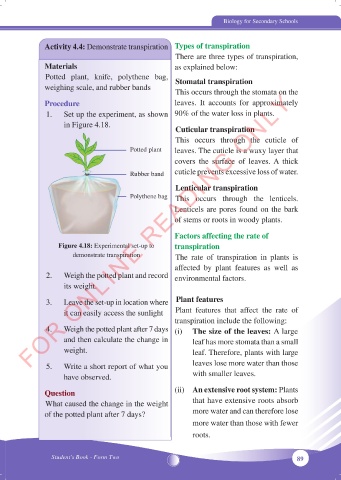
               Activity 4.4: Demonstrate transpiration Types of transpiration
                                                      There are three types of transpiration,
               Materials                              as explained below:
               Potted plant, knife, polythene bag,    Stomatal transpiration
               weighing scale, and rubber bands
          FOR ONLINE READING ONLY
                                                      This occurs through the stomata on the
               Procedure                              leaves.  It accounts  for approximately
               1.   Set up the experiment, as shown  90% of the water loss in plants.
                    in Figure 4.18.
                                                      Cuticular transpiration
                                                      This occurs through the cuticle  of
                                        Potted plant  leaves. The cuticle is a waxy layer that
                                                      covers the surface of leaves. A thick

                                        Rubber band   cuticle prevents excessive loss of water.
                                                      Lenticular transpiration
                                        Polythene bag  This occurs through the lenticels.
                                                      Lenticels are pores found on the bark
                                                      of stems or roots in woody plants.


                                                      Factors affecting the rate of
                   Figure 4.18: Experimental set-up to   transpiration
                       demonstrate transpiration      The rate of transpiration  in plants is

                                                      affected by plant features as well as
               2.   Weigh the potted plant and record   environmental factors.
                    its weight.

               3.   Leave the set-up in location where   Plant features
                    it can easily access the sunlight   Plant  features  that  affect  the  rate  of
                                                      transpiration include the following:
               4.   Weigh the potted plant after 7 days   (i)   The size of the leaves: A large
                    and then calculate the change in       leaf has more stomata than a small
                    weight.                                leaf. Therefore, plants with large

               5.   Write a short report of what you       leaves lose more water than those
                    have observed.                         with smaller leaves.

               Question                               (ii)  An extensive root system: Plants
               What caused the change in the weight        that have extensive roots absorb
               of the potted plant after 7 days?           more water and can therefore lose
                                                           more water than those with fewer
                                                           roots.


                 Student’s Book - Form Two                                                 89


                                                                                          05/10/2024   15:36:35
     BIOLOGY FORM 2 NEW.indd   89                                                         05/10/2024   15:36:35
     BIOLOGY FORM 2 NEW.indd   89

