


Page 24 - Chemistry_Form_2
P. 24
Chemistry
                                                                           for Secondary Schools


              Exercise 1.2

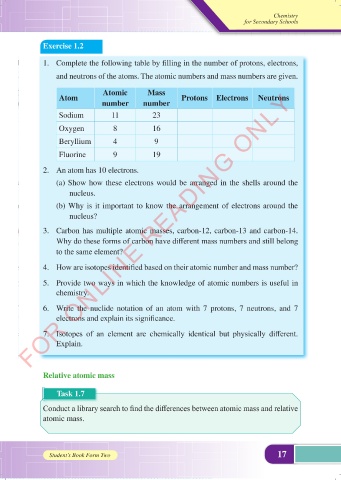
              1.  Complete the following table by filling in the number of protons, electrons,
                  and neutrons of the atoms. The atomic numbers and mass numbers are given.

          FOR ONLINE READING ONLY
                                Atomic        Mass
                   Atom                                 Protons   Electrons    Neutrons
                                number      number
                   Sodium          11          23
                   Oxygen          8           16

                   Beryllium       4            9
                   Fluorine        9           19

              2.  An atom has 10 electrons.
                  (a) Show how these electrons would be arranged in the shells around the
                      nucleus.

                  (b) Why is it important to know the arrangement of electrons around the
                      nucleus?
              3.  Carbon has multiple atomic masses, carbon-12, carbon-13 and carbon-14.
                  Why do these forms of carbon have different mass numbers and still belong
                  to the same element?

              4.  How are isotopes identified based on their atomic number and mass number?

              5.  Provide two ways in which the knowledge of atomic numbers is useful in
                  chemistry.

              6.  Write  the nuclide  notation  of an  atom  with  7 protons, 7 neutrons,  and  7
                  electrons and explain its significance.

              7.  Isotopes  of  an  element  are  chemically  identical  but  physically  different.
                  Explain.


              Relative atomic mass

                  Task 1.7

              Conduct a library search to find the differences between atomic mass and relative
              atomic mass.


                Student’s Book Form Two                                              17


                                                                                          01/08/2025   11:20:51
     CHEMISTRY FORM TWO NEW 2025 DUMMY.indd   17                                          01/08/2025   11:20:51
     CHEMISTRY FORM TWO NEW 2025 DUMMY.indd   17

