


Page 77 - Chemistry_Form_2
P. 77
Chemistry
              for Secondary Schools


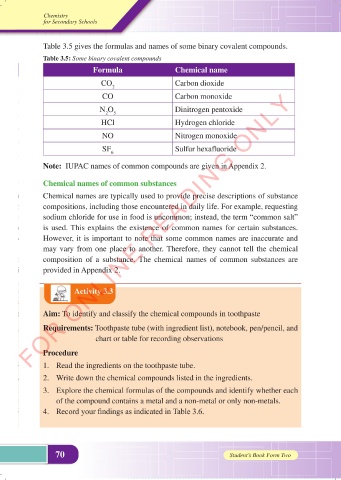
              Table 3.5 gives the formulas and names of some binary covalent compounds.
              Table 3.5: Some binary covalent compounds
                             Formula                  Chemical name

                                CO 2                  Carbon dioxide
          FOR ONLINE READING ONLY
                                CO                    Carbon monoxide

                               N O                    Dinitrogen pentoxide
                                 2  5
                                HCl                   Hydrogen chloride
                                NO                    Nitrogen monoxide

                                SF 6                  Sulfur hexafluoride

              Note:   IUPAC names of common compounds are given in Appendix 2.


              Chemical names of common substances
              Chemical names are typically used to provide precise descriptions of substance
              compositions, including those encountered in daily life. For example, requesting
              sodium chloride for use in food is uncommon; instead, the term “common salt”
              is used. This explains the existence of common names for certain substances.
              However, it is important to note that some common names are inaccurate and
              may vary from one place to another. Therefore, they cannot tell the chemical
              composition  of a substance.  The  chemical  names  of common  substances  are
              provided in Appendix 2.


                       Activity 3.3


              Aim: To identify and classify the chemical compounds in toothpaste

              Requirements: Toothpaste tube (with ingredient list), notebook, pen/pencil, and
                              chart or table for recording observations

              Procedure
              1.  Read the ingredients on the toothpaste tube.
              2.  Write down the chemical compounds listed in the ingredients.

              3.  Explore the chemical formulas of the compounds and identify whether each
                  of the compound contains a metal and a non-metal or only non-metals.
              4.  Record your findings as indicated in Table 3.6.


                  70                                                  Student’s Book Form Two


                                                                                          01/08/2025   11:20:57
     CHEMISTRY FORM TWO NEW 2025 DUMMY.indd   70                                          01/08/2025   11:20:57
     CHEMISTRY FORM TWO NEW 2025 DUMMY.indd   70

