


Page 174 - Mathematics_Form_Two
P. 174
Trigonometry


           From Figure 8.3, it follows that           Using the Pythagoras' theorem, it implies
           BD =  DC  = 1 unit.                        that, PR =  1 +  2  1 =  2  2 units.
           Apply the Pythagoras' theorem:

            BD +  2  AD =  2  = 2 AB 2                The following trigonometric ratios are
                          2
                                                      obtained.
                   2
            2
                      2
           1 +  AD =  4 1 3−= 2                       tan 45º  =  RQ  = = 1,
               AD =
          FOR ONLINE READING ONLY
                                                                PQ
                                                                      1
                                                             0
                                                       tan 45
     Mathematics for Secondary Schools  Thus, the following trigonometric ratios   sin 45º  =  PQ  = =  1 1  = =  2 2 2 , .
               2
                                                                      1
            AD =
                   3 units.
                                                                PR
                                                                        2
           are obtained.
                                                                 RQ
                                                      cos 45º  =
                                                                             2
                                                                 PR
                                                                        2
                     AD
            sin 60
                 0
           sin 60° =
                     AB  =  2 3  ,                    Values of sin 90°, cos 90°, and tan 90°
                     AD      3
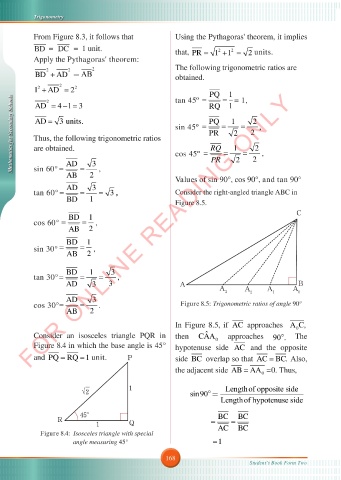
           tan 60° =     =     =  3 ,                 Consider the right-angled triangle ABC in
                     BD     1                         Figure 8.5.
                      BD    1
            cos60
                  0
           cos 60° =      =   ,
                      AB    2
                     BD    1
            sin30 =
                 0
           sin 30°       =   ,
                     AB    2
                     BD     1      3
            tan30
                 0
           tan 30°=      =     =     ,
                     AD      3    3
                     AD      3
           cos30
                 0
           cos 30°=      =     .                        Figure 8�5: Trigonometric ratios of angle 90°
                     AB     2
                                                      In Figure 8.5, if  AC approaches   A C,
                                                                                           0
                                                               ˆ
           Consider an  isosceles triangle PQR  in  then  CAA  approaches           90°.   The
                                                                  0
           Figure 8.4 in which the base angle is 45°   hypotenuse side  AC and the opposite
           and  PQ =  RQ 1= unit.                     side  BC  overlap so that  AC =  BC. Also,

                                                                                   O.
                                                      the adjacent side AB AA=  0  =0. Thus,
                                                                     Lengthof opposite side
                                                             sin90°=                         .
                                                                    Lengthof hypotenuse side
                                                                   BC    BC
                                                                          =  =
               Figure 8�4:  Isosceles triangle with special        AC    BC
                            angle measuring 45°                            1=

                                                   168
                                                                            Student's Book Form Two


                                                                                          11/10/2024   20:13:49
     MATHEMATIC F2 v5.indd   168
     MATHEMATIC F2 v5.indd   168                                                          11/10/2024   20:13:49

