


Page 192 - Mathematics_Form_Two
P. 192
Trigonometry


             3.  In the third scenario,  observe an    Example 8�21
                object which is at a position which
                you need  to  look  upwards. For       From the top of a tower, the  angle of
                instance, looking at the top of the    depression of a point on the ground 10 m
                building.                              away  from  the  base  of  a  tower  is  60º.
                                                       How high is the tower?
             4.  Study and reflect on all three cases   Solution
          FOR ONLINE READING ONLY
     Mathematics for Secondary Schools  5.  Use the internet or other relevant
                and discover features such as
                angles formed, and possibilities of
                                                       Consider the following figure.
                determining distances between the
                observer  and the  objects  without
                measurements.


                sources  to  study  and  justify  your
                observations  and share your
                findings through visual diagrams.


           In  Activity  8.5, it  can be deduced  that
           observing  an object  below or above
           the horizontal level, the line of sight
           forms an angle below or above.  An
           angle  formed between  a horizontal         Let A be the top point of the tower, C
           level  and  a  line  of  sight  by  observing   be the point of observation and B be the
           an object downward is called  an  angle     base of the tower. Thus,  tan60° =  AB  .
           of depression.  The  angle  formed  by      It follows that,                 10 m
           observing an object upwards is called an
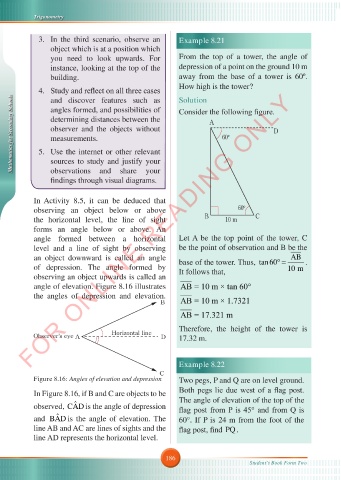
           angle of elevation. Figure 8.16 illustrates
           the  angles of depression and  elevation.


                                                       Therefore,  the height  of the tower is
                                                       17.32 m.


                                                       Example 8�22

           Figure 8�16: Angles of elevation and depression  Two pegs, P and Q are on level ground.
           In Figure 8.16, if B and C are objects to be   Both pegs lie due west of a flag post.
                                                       The angle of elevation of the top of the
                       ˆ
           observed, CAD is the angle of depression    flag post from P is 45° and from Q is
                  ˆ
           and  BAD is the  angle  of elevation. The   60°. If P is 24 m from the foot of the
           line AB and AC are lines of sights and the   flag post, find PQ.
           line AD represents the horizontal level.


                                                   186
                                                                            Student's Book Form Two


                                                                                          11/10/2024   20:14:15
     MATHEMATIC F2 v5.indd   186
     MATHEMATIC F2 v5.indd   186                                                          11/10/2024   20:14:15

