


Page 44 - Mathematics_Form_Two
P. 44
Similarity


           2.  Measure the lengths of  sides and angles of both shapes, then find the ratio of the
               corresponding side lengths.
           3.  Use your observations to make a general conclusion about the shapes, and explore
               additional sources such as the internet and books to enrich your competence.

           4.  Reflect on real objects around you with similar features and characteristics and
          FOR ONLINE READING ONLY
               share your insights.
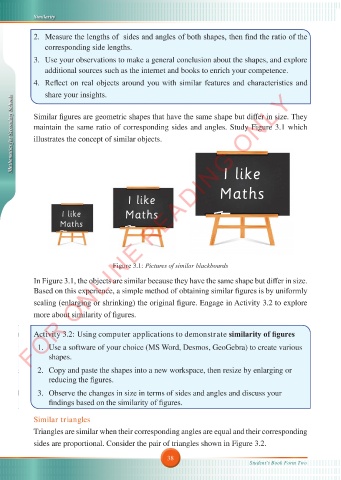
     Mathematics for Secondary Schools  Similar figures are geometric shapes that have the same shape but differ in size. They


           maintain the same ratio of corresponding sides and angles. Study Figure 3.1 which
           illustrates the concept of similar objects.


                                   Figure 3�1: Pictures of similar blackboards

           In Figure 3.1, the objects are similar because they have the same shape but differ in size.
           Based on this experience, a simple method of obtaining similar figures is by uniformly
           scaling (enlarging or shrinking) the original figure. Engage in Activity 3.2 to explore
           more about similarity of figures.


           Activity 3�2: Using computer applications to demonstrate similarity of figures
            1.  Use a software of your choice (MS Word, Desmos, GeoGebra) to create various
                shapes.

            2.  Copy and paste the shapes into a new workspace, then resize by enlarging or
                reducing the figures.
            3.  Observe the changes in size in terms of sides and angles and discuss your
                findings based on the similarity of figures.

           Similar triangles
           Triangles are similar when their corresponding angles are equal and their corresponding

           sides are proportional. Consider the pair of triangles shown in Figure 3.2.

                                                    38
                                                                            Student's Book Form Two


                                                                                          11/10/2024   20:11:28
     MATHEMATIC F2 v5.indd   38
     MATHEMATIC F2 v5.indd   38                                                           11/10/2024   20:11:28

