


Page 52 - Mathematics_Form_Two
P. 52
Similarity
Proof
Solution
ˆ
ˆ
LOU = OMU = 40° (given) (a) The numerators contain the
ˆ
ˆ
OUL = MUO = 90° (given) vertices A, D, and C while the
ˆ
ˆ
ULO = UOM = 50° denominators contain A, B, and C.
(third angles in triangles) Thus, the two triangles are ADC
FOR ONLINE READING ONLY
and ABC.
Mathematics for Secondary Schools (b) ∆CBA and ∆RPQ are not similar From CAB (each measures 90°)
Therefore,
OUL ~ MUO
ADC
ABC
(by AA-similarity theorem).
. It
and
follows that,
ˆ
ˆ
ADC =
because the corresponding angles
are not equal.
ˆ
ˆ
ACB
ACD =
(common)
(c) Required to prove that ∆SVU ∼
∆SWT Thus, DCA ~ ACB (by AA -
similarity theorem).
Proof DCA ~ ACB
The ratio of the corresponding sides Since , then the
ratio of the corresponding sides are
SW = 10 cm = 3 , equal, that is:
1
SV 13 cm 4
3
ST 9 cm 3 TW 6 cm 3 CD = CA = DA
= = , and = = AC CB AB
SU 12 cm 4 UV 8 cm 4
AD DC AD CD
ST = 9 cm = 3 , and TW = 6 cm = 3 . Therefore, = or = .
SU 12 cm 4 UV 8 cm 4 AB AC AB AC
Therefore, SVU ~ SWT (b) Vertices appearing in the
(by SSS-Similarity theorem). numerators are A, B and D, while
in the denominators are A, D and C.
Example 3�6 Thus, the triangles ADC and BDA
are obtained.
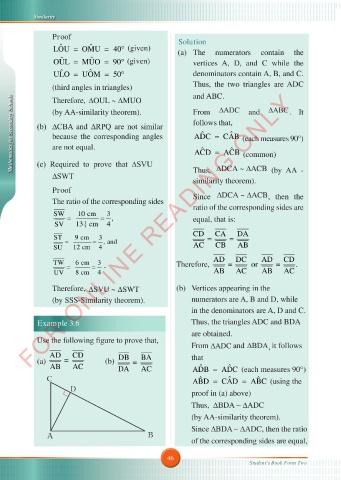
Use the following figure to prove that,
From ADC and BDA , it follows
AD CD DB BA that
(a) = (b) =
ˆ
AB AC DA AC ADB = ADC (each measures 90°)
ˆ
ˆ
ˆ
ˆ
ABD = CAD = ABC (using the
proof in (a) above)
Thus, ∆BDA ~ ∆ADC
(by AA-similarity theorem).
Since ∆BDA ~ ∆ADC, then the ratio
of the corresponding sides are equal,
46
Student's Book Form Two
11/10/2024 20:11:34
MATHEMATIC F2 v5.indd 46
MATHEMATIC F2 v5.indd 46 11/10/2024 20:11:34

