


Page 218 - Physics_Form_2
P. 218
Physics for Secondary Schools


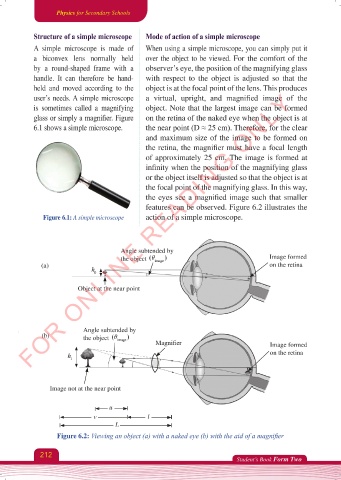
           Structure of a simple microscope  Mode of action of a simple microscope
           A simple microscope is made of    When using a simple microscope, you can simply put it
           a biconvex lens normally held     over the object to be viewed. For the comfort of the
           by a round-shaped frame with a    observer’s eye, the position of the magnifying glass
           handle. It can therefore be hand-  with respect to the object is adjusted so  that the
           held and moved according to the   object is at the focal point of the lens. This produces
          FOR ONLINE READING ONLY
           user’s needs. A simple microscope   a  virtual,  upright,  and  magnified  image  of  the
           is sometimes called a magnifying   object. Note that the largest image can be formed
           glass or simply a magnifier. Figure   on the retina of the naked eye when the object is at
           6.1 shows a simple microscope.    the near point (D ≈ 25 cm). Therefore, for the clear
                                             and maximum size of the image to be formed on
                                             the retina, the magnifier must have a focal length
                                             of approximately 25 cm. The image is formed at
                                             infinity when the position of the magnifying glass
                                             or the object itself is adjusted so that the object is at
                                             the focal point of the magnifying glass. In this way,
                                             the eyes see a magnified image such that smaller
                                             features can be observed. Figure 6.2 illustrates the
              Figure 6.1: A simple microscope  action of a simple microscope.


                                      Angle subtended by
                                      the object  (θ image )                       Image formed
              (a)                                                                  on the retina
                             h 0


                         Object at the near point


                          Angle subtended by
              (b)         the object  (θ image )  Magnifier                        Image formed


                     h 1                                                           on the retina


                Image not at the near point


                                  u
                             v                l
                                    L

                  Figure 6.2: Viewing an object (a) with a naked eye (b) with the aid of a magnifier

             212
                                                                         Student’s Book Form Two


     Physics Form 2 Final.indd   212                                                        25/10/2025   10:28

