


Page 348 - Biology_F5
P. 348
Regulation (Homeostasis)

           (b) Water balance                          by producing a blood vessel constricting
           As kidneys are key in the chemical  protein, angiotensin,  which also signals
           breakdown of urine, they react to changes   the body to retain sodium and water. Both
           in the body’s water level every minute. As   constriction  and  retention  help  restore
           water intake decreases, the kidneys adjust   normal blood pressure.
          FOR ONLINE READING ONLY
           accordingly and leave water in the body
           instead of helping to excrete it.          (d) Red blood cell regulation
                                                      When  the  kidneys do not get  enough
           (c) Blood pressure regulation              oxygen, they send out a distress call  in
           The  kidneys  need  constant  pressure to   the form of erythropoietin; a hormone that
           filter the blood. When it drops too low, the   stimulates  the bone marrow to produce
           kidneys increase the pressure. One way is   more red blood cells.  This process is
                                                      called erythropoiesis.

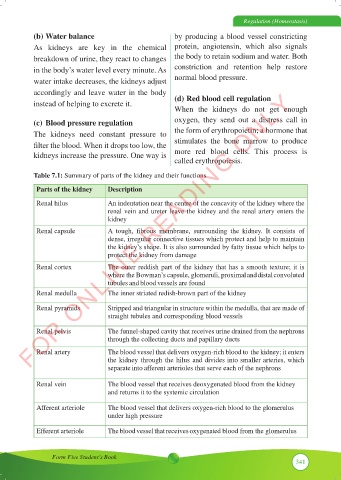
           Table 7.1: Summary of parts of the kidney and their functions

            Parts of the kidney   Description

            Renal hilus           An indentation near the centre of the concavity of the kidney where the
                                  renal vein and ureter leave the kidney and the renal artery enters the
                                  kidney

            Renal capsule         A  tough,  fibrous  membrane,  surrounding  the  kidney. It consists of
                                  dense, irregular connective tissues which protect and help to maintain
                                  the kidney’s shape. It is also surrounded by fatty tissue which helps to
                                  protect the kidney from damage

            Renal cortex          The outer reddish part of the kidney that has a smooth texture; it is
                                  where the Bowman’s capsule, glomeruli, proximal and distal convoluted
                                  tubules and blood vessels are found
            Renal medulla         The inner striated redish-brown part of the kidney

            Renal pyramids        Stripped and triangular in structure within the medulla, that are made of
                                  straight tubules and corresponding blood vessels

            Renal pelvis          The funnel-shaped cavity that receives urine drained from the nephrons
                                  through the collecting ducts and papillary ducts

            Renal artery          The blood vessel that delivers oxygen-rich blood to the kidney; it enters
                                  the kidney through the hilus and divides into smaller arteries, which
                                  separate into afferent arterioles that serve each of the nephrons

            Renal vein            The blood vessel that receives deoxygenated blood from the kidney
                                  and returns it to the systemic circulation

            Afferent arteriole    The blood vessel that delivers oxygen-rich blood to the glomerulus
                                  under high pressure
            Efferent arteriole    The blood vessel that receives oxygenated blood from the glomerulus


                 Form Five Student’s Book
                                                                                          341

