


Page 350 - Biology_F5
P. 350
Regulation (Homeostasis)

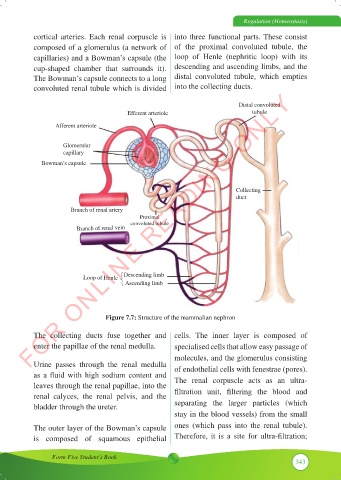
           cortical  arteries. Each  renal  corpuscle  is  into three functional parts. These consist
           composed of a glomerulus (a network of  of the proximal convoluted  tubule,  the
           capillaries) and a Bowman’s capsule (the   loop of Henle (nephritic  loop) with its
           cup-shaped chamber that surrounds  it).    descending and ascending limbs, and the
           The Bowman’s capsule connects to a long    distal  convoluted  tubule,  which  empties
           convoluted renal tubule which is divided   into the collecting ducts.
          FOR ONLINE READING ONLY
                                                                         Distal convoluted
                                        Efferent arteriole                   tubule
                  Afferent arteriole


                    Glomerular
                    capillary
              Bowman’s capsule


                                                                        Collecting
                                                                        duct

                      Branch of renal artery
                                           Proximal
                                        convoluted tubule
                        Branch of renal vein


                                      Descending limb
                          Loop of Henle
                                       Ascending limb


                                 Figure 7.7: Structure of the mammalian nephron

           The collecting  ducts fuse together  and  cells.  The inner layer is composed of
           enter the papillae of the renal medulla.   specialised cells that allow easy passage of

                                                      molecules, and the glomerulus consisting
           Urine passes through the renal  medulla    of endothelial cells with fenestrae (pores).
           as a fluid with high sodium content and    The  renal  corpuscle  acts  as an ultra-
           leaves through the renal papillae, into the
           renal  calyces,  the  renal  pelvis,  and the   filtration  unit,  filtering the blood and
           bladder through the ureter.                separating  the  larger particles  (which
                                                      stay in the blood vessels) from the small

           The outer layer of the Bowman’s capsule    ones (which  pass into  the  renal  tubule).
           is composed of squamous epithelial         Therefore,  it  is  a  site  for  ultra-filtration;


                 Form Five Student’s Book
                                                                                          343

