


Page 352 - Biology_F5
P. 352
Regulation (Homeostasis)

                            Afferent arteriole                Efferent arteriole


                         Capillary showing pore                  Capillaries of the glomerulus
                                  Podocyte
                              Filtration silts                     Squamous epithelial cells of

                          Basement membrane                        Bowman’s capsule
                                                                Glomerular filtrate
          FOR ONLINE READING ONLY
                                                                Microvilli
                                                              Cells of proximal  convoluted tubule
                    Basement membrane
                                                                      Tight junction
                                              Space between epithelial cells
                    Endothelium of
                    blood capillary                                   Microvilli
                             BLOOD                                GLOMERULAR FILTRATE


            Infolding of cell surface                                  Epithelial cell of proximal
                                                                       convoluted tubule
            membrane forming base
            channels
                                                Reabsorption

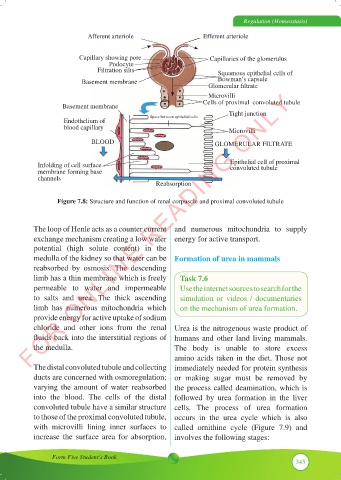
                  Figure 7.8: Structure and function of renal corpuscle and proximal convoluted tubule


           The loop of Henle acts as a counter current  and numerous mitochondria  to supply
           exchange mechanism creating a low water  energy for active transport.
           potential  (high solute content)  in the
           medulla of the kidney so that water can be  Formation of urea in mammals
           reabsorbed by osmosis.  The descending
           limb has a thin membrane which is freely    Task 7.6
           permeable  to  water  and  impermeable      Use the internet sources to search for the
           to salts  and  urea.  The thick  ascending   simulation or videos / documentaries
           limb  has  numerous  mitochondria  which    on the mechanism of urea formation.
           provide energy for active uptake of sodium
           chloride  and other ions from the renal  Urea is the nitrogenous waste product of
           fluids back into the interstitial regions of  humans and other land living mammals.
           the medulla.                               The body is unable to store excess
                                                      amino acids taken in the diet. Those not
           The distal convoluted tubule and collecting  immediately needed for protein synthesis
           ducts are concerned with osmoregulation;  or making  sugar must be  removed  by
           varying  the  amount  of water  reabsorbed  the process called deamination, which is
           into  the blood.  The  cells of the  distal  followed by  urea formation  in the liver
           convoluted tubule have a similar structure  cells.  The  process of  urea  formation
           to those of the proximal convoluted tubule,  occurs in the  urea cycle  which is also
           with  microvilli lining inner surfaces to  called  ornithine cycle (Figure 7.9) and
           increase  the  surface  area  for absorption,  involves the following stages:


                 Form Five Student’s Book
                                                                                          345

