


Page 163 - Computer_Science_F5
P. 163
Computer Science  inter-process communication, as shown  and up to 254 valid hosts per network.
           in Table 3.2.
                                                     Class C addresses range from 192.0.0.0
                                                     to 223.255.255.255 in decimal notation,
           Class B
                                                     encompassing the range from 192 to 223
           Class B addresses  are  assigned to  for the first octet, as shown in Table 3.2.
          FOR ONLINE READING ONLY
           networks ranging from medium-sized to
           large-sized. In a Class B address, the two   Class D
           highest-order bits are always set to binary  Class D addresses are specifically reserved
           10. The following 14 bits (completing  for IP multicast addresses. In a Class D
           the first two octets) form the network    address, the four highest-order bits are
           ID, while the remaining 16 bits (last     always set to binary 1110. The remaining
           two octets) represent the host ID. This   bits are used for the multicast group address
           allocation allows for 16,384 networks     that interested hosts recognise. Class D
           and up to 65,534 valid hosts per network.   addresses are supported by applications
           Class B addresses span from 128.0.0.0     to multicast data to hosts capable of
           to 191.255.255.255 in decimal notation,
           encompassing the range from 128 to 191    receiving multicast on an internetwork.
           for the first octet, as shown in Table 3.2.  Class D addresses range from 224.0.0.0
                                                     to 239.255.255.255 in decimal notation,
           Class C                                   covering the first octet values from 224
           Class C addresses are assigned to small-  to 239, as shown in Table 3.2.
           sized networks. In a Class C address,
           the three highest-order bits are always   Class E
           set to binary 110. The following 21 bits   Class E is an address class designated
           (completing the first three octets) form   for experimental purposes and reserved
           the network ID, while the remaining 8     for future use. In a Class E address, the
           bits (last octet) represent the host ID. This  four highest-order bits are set to binary
           allocation allows for 2,097,152 networks  1111, as shown in Table 3.2.

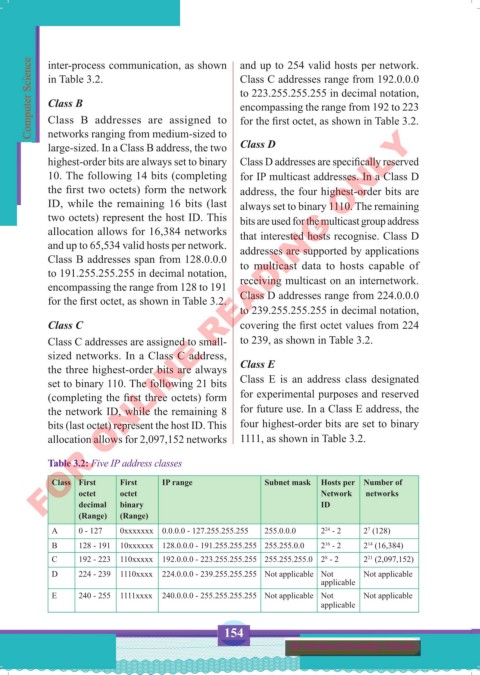
           Table 3.2: Five IP address classes

            Class First    First    IP range              Subnet mask  Hosts per  Number of
                  octet    octet                                      Network    networks
                  decimal   binary                                    ID
                  (Range)  (Range)

                                                                       24
            A     0 - 127  0xxxxxxx  0.0.0.0 - 127.255.255.255  255.0.0.0  2  - 2  2  (128)
                                                                                7
                                                                                14
                                                                       16
            B     128 - 191  10xxxxxx  128.0.0.0 - 191.255.255.255 255.255.0.0  2  - 2  2  (16,384)
            C     192 - 223  110xxxxx  192.0.0.0 - 223.255.255.255 255.255.255.0 2  - 2  2  (2,097,152)
                                                                       8
                                                                                21
            D     224 - 239  1110xxxx  224.0.0.0 - 239.255.255.255 Not applicable Not   Not applicable
                                                                      applicable
            E     240 - 255  1111xxxx  240.0.0.0 - 255.255.255.255 Not applicable Not   Not applicable
                                                                      applicable
                                                 154
                                                                for Advanced Secondary Schools


     Computer Science Form 5.indd   154                                                     23/07/2024   12:33

