


Page 246 - Computer_Science_F5
P. 246
(a) Identify all errors in the program.

                   (b) Correct errors before running the program.
                   (c) Run the program and display the results.
               2.  Describe five (5) characteristics of a good program.                            Chapter Four: Object oriented programming with C++
          FOR ONLINE READING ONLY
               3.  Will the following lines of code in (a) and (b) print the same thing? Explain
                   why or  why not.
                   (a) cout << 5 << ‘\n’;
                   (b) cout << “5” << ‘\n’;

               4.  Will the following lines of code print the same thing? Explain why or why not.
                   (a) cout << y<< ‘\n’;
                   (b) cout << “y” << ‘\n’;


              Data types
              C++ programming language supports various types of data. Each data type defines
              its memory size, and improves the running speed of the program. C++ programming
              language provides different types of data based on numeric values, Boolean values,
              and  characters  under  a  specific  range  of  values.  C++  programming  language  is
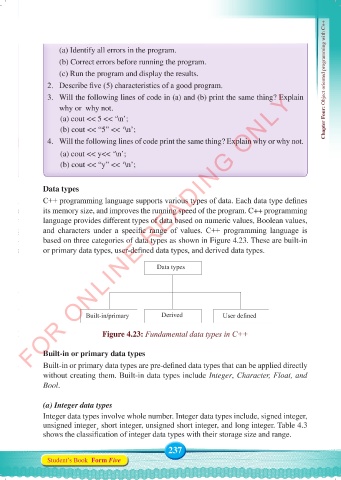
              based on three categories of data types as shown in Figure 4.23. These are built-in
              or primary data types, user-defined data types, and derived data types.


                                                Data types


                           Built-in/primary       Derived           User defined

                                Figure 4.23: Fundamental data types in C++


              Built-in or primary data types
              Built-in or primary data types are pre-defined data types that can be applied directly
              without creating them. Built-in data types include Integer, Character, Float, and
              Bool.


              (a) Integer data types
              Integer data types involve whole number. Integer data types include, signed integer,
              unsigned integer¸ short integer, unsigned short integer, and long integer. Table 4.3
              shows the classification of integer data types with their storage size and range.

                                                    237
               Student’s Book  Form Five


     Computer Science Form 5.indd   237                                                     23/07/2024   12:33

