


Page 244 - Computer_Science_F5
P. 244
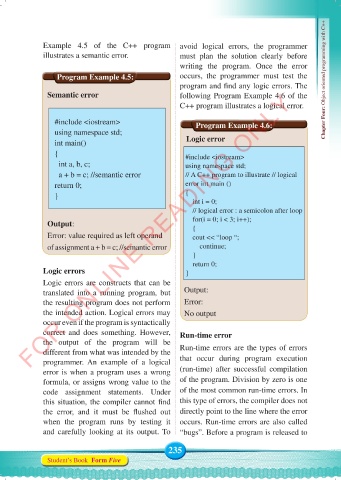
Example  4.5 of the C++ program  avoid  logical  errors,  the  programmer
              illustrates a semantic error.            must  plan  the  solution  clearly  before
                                                       writing the program. Once the error

                     Program Example 4.5:              occurs, the  programmer  must test  the
                                                       program and find any logic errors. The      Chapter Four: Object oriented programming with C++
          FOR ONLINE READING ONLY
               Semantic error                          following Program Example 4.6 of the
                                                       C++ program illustrates a logical error.

                  #include <iostream>                          Program Example 4.6:
                  using namespace std;
                  int main()                              Logic error
                  {                                      #include <iostream>
                    int a, b, c;                         using namespace std;
                    a + b = c; //semantic error          // A C++ program to illustrate // logical
                  return 0;                              error int main ()
                  }                                      {
                                                             int i = 0;
                                                             // logical error : a semicolon after loop
                                                             for(i = 0; i < 3; i++);
               Output:                                       {

               Error: value required as left operand         cout << “loop “;
               of assignment a + b = c; //semantic error          continue;
                                                             }
                                                             return 0;
              Logic errors                               }
              Logic errors are constructs that can be
              translated  into a running program, but    Output:
              the resulting program does not perform     Error:
              the intended action. Logical errors may    No output
              occur even if the program is syntactically
              correct  and does something. However,    Run-time error
              the output of the program will be
              different from what was intended by the   Run-time errors are the types of errors
              programmer.  An example  of a logical    that occur during program execution
              error is when a program uses a wrong     (run-time)  after  successful compilation
              formula, or assigns wrong value to the   of the program. Division by zero is one
              code assignment  statements.  Under      of the most common run-time errors. In
              this situation, the compiler cannot find  this type of errors, the compiler does not
              the  error,  and  it  must  be  flushed  out  directly point to the line where the error
              when the program runs by testing it  occurs. Run-time errors are also called
              and carefully  looking at its output.  To  “bugs”. Before a program is released to

                                                    235
               Student’s Book  Form Five


     Computer Science Form 5.indd   235                                                     23/07/2024   12:33

