


Page 359 - Computer_Science_F5
P. 359
Computer Science  (d) Types of constructors
           In Java, there are two main types of constructors:
             (i)  Default constructor: Is a kind of constructor that has no arguments (empty
                parentheses). It is used to give basic default values for the properties of a
          FOR ONLINE READING ONLY
                particular object. Java tends to create a default constructor automatically that is
                not initialised if a constructor is not declared in your class. Program Example
                5.20 demonstrates the default constructor.


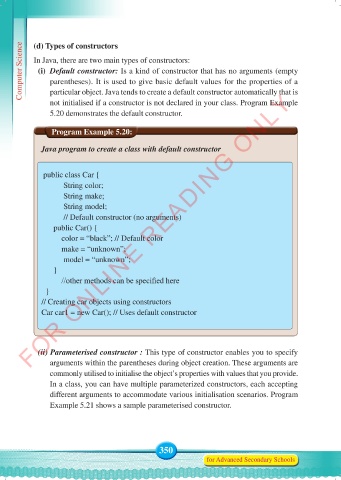
                    Program Example 5.20:

             Java program to create a class with default constructor


               public class Car {
                      String color;
                     String make;
                     String model;
                     // Default constructor (no arguments)
                    public Car() {
                     color = “black”; // Default color
                     make = “unknown”;
                     model = “unknown”;
                    }
                    //other methods can be specified here
                }
              // Creating car objects using constructors
              Car car1 = new Car(); // Uses default constructor


             (ii) Parameterised constructor : This type of constructor enables you to specify
                arguments within the parentheses during object creation. These arguments are
                commonly utilised to initialise the object’s properties with values that you provide.
                In a class, you can have multiple parameterized constructors, each accepting
                different arguments to accommodate various initialisation scenarios. Program
                Example 5.21 shows a sample parameterised constructor.


                                                 350
                                                                for Advanced Secondary Schools


     Computer Science Form 5.indd   350                                                     23/07/2024   12:34

