


Page 393 - Computer_Science_F5
P. 393
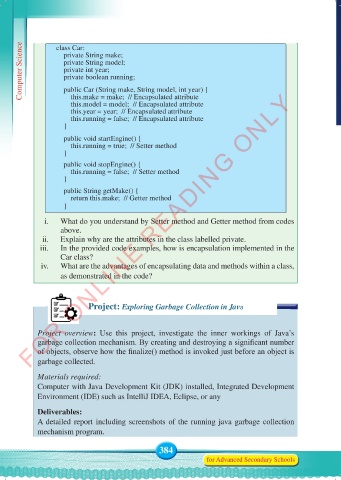
Computer Science  class Car:
                      private String make;
                      private String model;
                      private int year;
                      private boolean running;
                      public Car (String make, String model, int year) {
          FOR ONLINE READING ONLY
                          this.make = make;  // Encapsulated attribute
                          this.model = model;  // Encapsulated attribute
                          this.year = year;  // Encapsulated attribute
                          this.running = false;  // Encapsulated attribute
                      }
                      public void startEngine() {
                          this.running = true;  // Setter method
                      }
                      public void stopEngine() {
                          this.running = false;  // Setter method
                      }
                      public String getMake() {
                          return this.make;  // Getter method
                      }

              i.   What do you understand by Setter method and Getter method from codes
                   above.
              ii.   Explain why are the attributes in the class labelled private.
             iii.   In the provided code examples, how is encapsulation implemented in the
                   Car class?
             iv.   What are the advantages of encapsulating data and methods within a class,
                   as demonstrated in the code?


                            Project: Exploring Garbage Collection in Java


            Project overview: Use this project, investigate the inner workings of Java’s
            garbage collection mechanism. By creating and destroying a significant number
            of objects, observe how the finalize() method is invoked just before an object is
            garbage collected.

            Materials required:
            Computer with Java Development Kit (JDK) installed, Integrated Development
            Environment (IDE) such as IntelliJ IDEA, Eclipse, or any

            Deliverables:
            A detailed report including screenshots of the running java garbage collection
            mechanism program.


                                                 384
                                                                for Advanced Secondary Schools


     Computer Science Form 5.indd   384                                                     23/07/2024   12:34

