


Page 448 - Computer_Science_F5
P. 448
(d) Object-Oriented database model
              In contrast  to relational  databases,  which are  table-oriented,  an  object-oriented
              database  architecture  represents  both  the  data  and  the  relationship  in  a  single
              structure called an object. The object-oriented data model better represents real-
              world problems. It allows us to store music, video, photographs, and other data      Chapter Eight: Databases and Database Management Systems
          FOR ONLINE READING ONLY
              types in databases, which was not possible or efficient in the relational paradigm.
              Furthermore, in this object-oriented database architecture, two or more objects with
              various properties and methods are linked together, as in today’s object-oriented
              databases and programming languages. These links are used to connect one thing
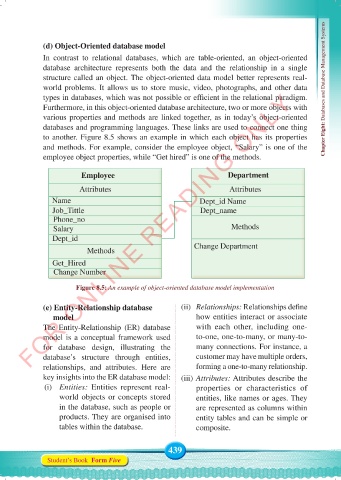
              to another. Figure 8.5 shows an example in which each object has its properties
              and methods. For example, consider the employee object, “Salary” is one of the
              employee object properties, while “Get hired” is one of the methods.

                          Employee                                    Department

                         Attributes                                   Attributes
                 Name                                        Dept_id Name
                 Job_Tittle                                   Dept_name
                 Phone_no
                 Salary                                                Methods
                 Dept_id
                           Methods                          Change Department

                 Get_Hired
                 Change Number


                        Figure 8.5: An example of object-oriented database model implementation

              (e) Entity-Relationship database          (ii)  Relationships: Relationships define
                   model                                    how entities interact or associate
              The  Entity-Relationship  (ER) database       with each other, including one-
              model is a conceptual framework used          to-one, one-to-many, or many-to-
              for database design, illustrating  the        many connections. For instance, a
              database’s structure through entities,        customer may have multiple orders,
              relationships,  and attributes. Here are      forming a one-to-many relationship.
              key insights into the ER database model:  (iii) Attributes: Attributes describe the
              (i)  Entities: Entities represent real-       properties or characteristics of
                   world objects or concepts stored         entities, like names or ages. They
                   in the database, such as people or       are represented as columns within
                   products. They are organised into        entity tables and can be simple or
                   tables within the database.              composite.


                                                    439
               Student’s Book  Form Five


     Computer Science Form 5.indd   439                                                     23/07/2024   12:34

