


Page 450 - Computer_Science_F5
P. 450
Relational database
              A  relational  database  is  a  collection  of  data  elements  linked  by  predefined
              connections, organised into tables with columns and rows. It divides data into tables
              that can be connected based on shared data, allowing the creation of new tables
              from existing ones through queries. This structure enhances understanding of data    Chapter Eight: Databases and Database Management Systems
          FOR ONLINE READING ONLY
              relationships and supports better decision-making. For example, a school database
              might  include  tables  for pupils, family  members,  results, subjects, and teachers,
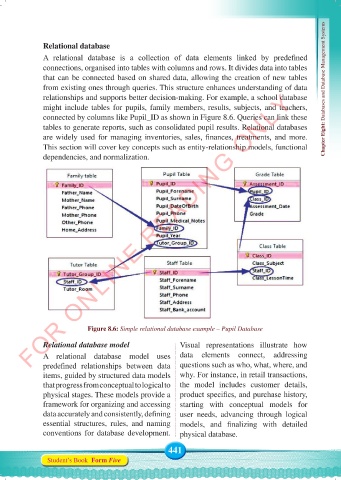
              connected by columns like Pupil_ID as shown in Figure 8.6. Queries can link these
              tables to generate reports, such as consolidated pupil results. Relational databases
              are widely used for managing inventories, sales, finances, treatments, and more.
              This section will cover key concepts such as entity-relationship models, functional
              dependencies, and normalization.


                            Figure 8.6: Simple relational database example – Pupil Database

              Relational database model                Visual representations  illustrate  how
              A relational database  model  uses       data  elements  connect,  addressing
              predefined  relationships  between  data  questions such as who, what, where, and
              items, guided by structured data models  why. For instance, in retail transactions,
              that progress from conceptual to logical to  the  model  includes  customer  details,
              physical stages. These models provide a  product specifics, and purchase history,
              framework for organizing and accessing  starting  with conceptual  models for
              data accurately and consistently, defining  user needs, advancing through logical
              essential  structures, rules, and naming  models,  and  finalizing  with  detailed
              conventions for database development.  physical database.

                                                    441
               Student’s Book  Form Five


     Computer Science Form 5.indd   441                                                     23/07/2024   12:34

