


Page 115 - Biology_Form_3
P. 115
Biology for Secondary Schools


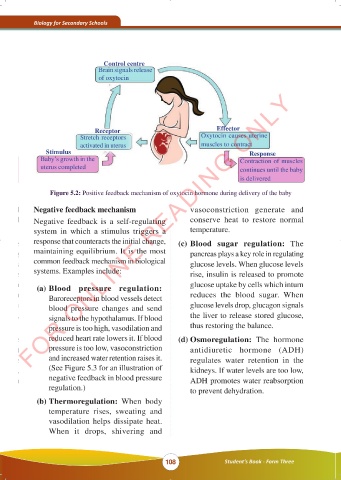
                                Control centre
                               Brain signals release
                               of oxytocin
          FOR ONLINE READING ONLY


                              Receptor                             Effector
                         Stretch receptors                    Oxytocin causes uterine
                         activated in uterus                  muscles to contract
               Stimulus                                                     Response
             Figure 5.2: Positive feedback mechanism of oxytocin hormone during delivery to facilitate labour
             Baby’s growth in the                                         Contraction of muscles
             uterus completed                                             continues until the baby
                                                                          is delivered

                Figure 5.2: Positive feedback mechanism of oxytocin hormone during delivery of the baby
           Negative feedback mechanism                     vasoconstriction generate and

           Negative  feedback  is  a  self-regulating      conserve heat to restore normal
           system in which a stimulus triggers a           temperature.
           response that counteracts the initial change,   (c) Blood sugar regulation: The
           maintaining equilibrium. It is the most         pancreas plays a key role in regulating
           common feedback mechanism in biological         glucose levels. When glucose levels
           systems. Examples include:                      rise, insulin is released to promote


            (a) Blood pressure regulation:                 glucose uptake by cells which inturn
                Baroreceptors in blood vessels detect      reduces the blood sugar.  When
                blood pressure changes and send            glucose levels drop, glucagon signals
                signals to the hypothalamus. If blood      the liver to release stored glucose,
                pressure is too high, vasodilation and     thus restoring the balance.
                reduced heart rate lowers it. If blood   (d) Osmoregulation: The  hormone
                pressure is too low, vasoconstriction      antidiuretic  hormone  (ADH)
                and increased water retention raises it.   regulates water retention in the
                (See Figure 5.3 for an illustration of     kidneys. If water levels are too low,
                negative feedback in blood pressure        ADH promotes water reabsorption
                regulation.)                               to prevent dehydration.

            (b) Thermoregulation: When  body
                temperature rises, sweating and
                vasodilation helps dissipate heat.
                When it drops, shivering and


                                                   108               Student’s Book - Form Three


     BIOLOGY FORM 3 FINAL EDITED 16.09.2025.indd   108                                    23/10/2025   11:52:47                     KAMISHNA
                                                                                          23/10/2025   11:52:47
     BIOLOGY FORM 3 FINAL EDITED 16.09.2025.indd   108


                                KAMISHNA

