


Page 113 - Biology_Form_3
P. 113
Biology for Secondary Schools


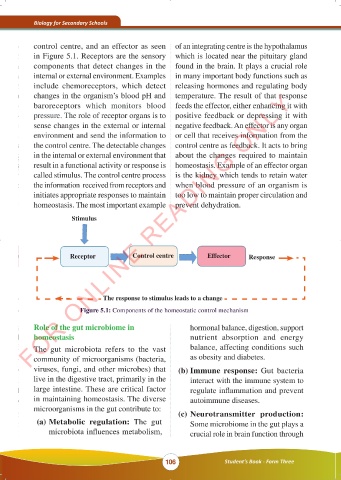
           control centre, and an effector as seen  of an integrating centre is the hypothalamus
           in Figure 5.1. Receptors are the sensory  which is located near the pituitary gland
           components that detect changes in the  found in the brain. It plays a crucial role
           internal or external environment. Examples  in many important body functions such as
           include chemoreceptors, which detect  releasing hormones and regulating body
          FOR ONLINE READING ONLY
           changes in the organism’s blood pH and  temperature. The result of that response
           baroreceptors which monitors blood  feeds the effector, either enhancing it with
           pressure. The role of receptor organs is to  positive feedback or depressing it with
           sense changes in the external or internal  negative feedback. An effector is any organ
           environment and send the information to  or cell that receives information from the
           the control centre. The detectable changes  control centre as feedback. It acts to bring
           in the internal or external environment that  about the changes required to maintain
           result in a functional activity or response is  homeostasis. Example of an effector organ
           called stimulus. The control centre process  is the kidney which tends to retain water
           the information  received from receptors and  when blood pressure of an organism is
           initiates appropriate responses to maintain  too low to maintain proper circulation and
           homeostasis. The most important example  prevent dehydration.
                       Stimulus


                      Receptor           Control centre         Effector    Response


                                The response to stimulus leads to a change
                         Figure 5.1: Components of the homeostatic control mechanism

           Role of the gut microbiome in                   hormonal balance, digestion, support
           homeostasis                                     nutrient absorption and energy
           The gut microbiota refers to the vast           balance, affecting conditions such
           community of microorganisms (bacteria,          as obesity and diabetes.
           viruses, fungi, and other microbes) that    (b) Immune response: Gut bacteria
           live in the digestive tract, primarily in the   interact with the immune system to
           large intestine. These are critical factor      regulate inflammation and prevent
           in maintaining homeostasis. The diverse         autoimmune diseases.
           microorganisms in the gut contribute to:    (c) Neurotransmitter production:

            (a) Metabolic  regulation: The  gut            Some microbiome in the gut plays a
                microbiota influences metabolism,          crucial role in brain function through


                                                   106               Student’s Book - Form Three


                                                                                          23/10/2025   11:52:46
     BIOLOGY FORM 3 FINAL EDITED 16.09.2025.indd   106
     BIOLOGY FORM 3 FINAL EDITED 16.09.2025.indd   106                                    23/10/2025   11:52:46                     KAMISHNA


                                KAMISHNA

