


Page 109 - Biology_Form_3
P. 109
Biology for Secondary Schools


             Column A                   Column B
                                        N.  A structure that collects urine from nephrones and
                                           channels it to the pelvis
                                        O.  The site of urine concentration in the nephrone
                                        P.     An organ that maintains homeostasis by excreting
          FOR ONLINE READING ONLY
                                           nitrogenous waste
                                        Q.  A hormone that promotes sodium retention and
                                           potassium excretion
                                        R.  The movement of blood under pressure through a
                                           semipermeable membrane
                                        S.    A cup-like structure enclosing the glomerulus in
                                           which filtration starts
                                        T.  A funnel-shaped structure that connects to the  ureter
                                           inside the kidney
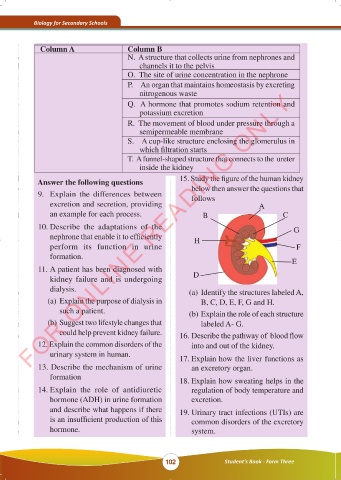
            Answer the following questions             15. Study the figure of the human kidney

             9.  Explain the differences between           below then answer the questions that
                                                           follows
                excretion and secretion, providing                             A
                an example for each process.                  B                        C

             10. Describe the adaptations  of  the                                        G
                nephrone that enable it to efficiently      H
                perform  its  function  in  urine                                          F
                formation.                                                               E

             11. A patient has been diagnosed with
                kidney failure and is undergoing           D
                dialysis.                                 (a)  Identify the structures labeled A,
               (a) Explain the purpose of dialysis in         B, C, D, E, F, G and H.
                   such a patient.                        (b) Explain the role of each structure
               (b) Suggest two lifestyle changes that         labeled A- G.
                   could help prevent kidney failure.  16. Describe the pathway of  blood flow
             12. Explain the common disorders of the       into and out of the kidney.
                urinary system in human.               17. Explain how the liver functions as
             13. Describe the mechanism of urine           an excretory organ.
                formation                              18. Explain how sweating helps in the

             14. Explain the role of antidiuretic          regulation of body temperature and
                hormone (ADH) in urine formation           excretion.
                and describe what happens if there     19. Urinary tract infections (UTIs) are
                is an insufficient production of this      common disorders of the excretory
                hormone.                                   system.


                                                   102               Student’s Book - Form Three


     BIOLOGY FORM 3 FINAL EDITED 16.09.2025.indd   102                                    23/10/2025   11:52:45                     KAMISHNA
                                                                                          23/10/2025   11:52:45
     BIOLOGY FORM 3 FINAL EDITED 16.09.2025.indd   102


                                KAMISHNA

