


Page 58 - Biology_Form_3
P. 58
Biology for Secondary Schools


                                                       Ciliary muscle relaxes


                                         Tight ligament
                Object at infinity                                                 Image
          FOR ONLINE READING ONLY

                                           Thin eye lens
                    Parallel ray from a
                    distant object                  (b)

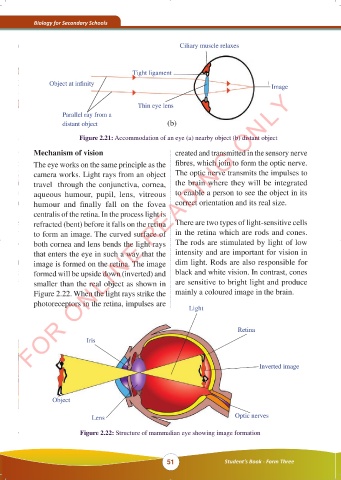
                         Figure 2.21: Accommodation of an eye (a) nearby object (b) distant object

           Mechanism of vision                        created and transmitted in the sensory nerve
           The eye works on the same principle as the   fibres, which join to form the optic nerve.
           camera works. Light rays from an object    The optic nerve transmits the impulses to
           travel  through the conjunctiva, cornea,   the brain where they will be integrated
           aqueous humour, pupil, lens, vitreous      to enable a person to see the object in its
           humour  and  finally  fall  on  the  fovea   correct orientation and its real size.
           centralis of the retina. In the process light is
           refracted (bent) before it falls on the retina   There are two types of light-sensitive cells
           to form an image. The curved surface of    in the retina which are rods and cones.
           both cornea and lens bends the light rays   The rods are stimulated by light of low
           that enters the eye in such a way that the   intensity and are important for vision in
           image is formed on the retina. The image   dim light. Rods are also responsible for
           formed will be upside down (inverted) and   black and white vision. In contrast, cones
           smaller than the real object as shown in   are sensitive to bright light and produce
           Figure 2.22. When the light rays strike the   mainly a coloured image in the brain.
           photoreceptors in the retina, impulses are
                                                          Light


                                                                         Retina
                           Iris


                                                                               Inverted image


                 Object

                             Lens                                       Optic nerves

                         Figure 2.22: Structure of mammalian eye showing image formation


                                                    51               Student’s Book - Form Three


                                                                                          23/10/2025   11:52:38
     BIOLOGY FORM 3 FINAL EDITED 16.09.2025.indd   51
     BIOLOGY FORM 3 FINAL EDITED 16.09.2025.indd   51 KAMISHNA                            23/10/2025   11:52:38                     KAMISHNA

