


Page 55 - Biology_Form_3
P. 55
Coordination in animals


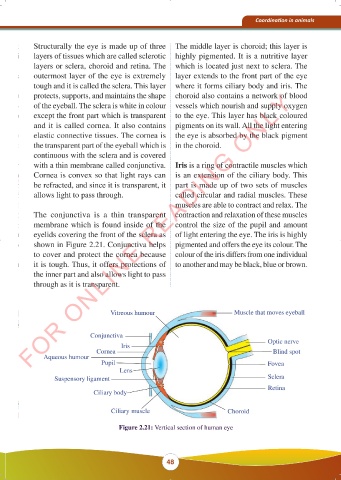
           Structurally the eye is made up of three  The middle layer is choroid; this layer is
           layers of tissues which are called sclerotic  highly pigmented. It is a nutritive layer
           layers or sclera, choroid and retina. The  which is located just next to sclera. The
           outermost layer of the eye is extremely  layer extends to the front part of the eye
           tough and it is called the sclera. This layer  where it forms ciliary body and iris. The
          FOR ONLINE READING ONLY
           protects, supports, and maintains the shape  choroid also contains a network of blood
           of the eyeball. The sclera is white in colour  vessels which nourish and supply oxygen
           except the front part which is transparent  to the eye. This layer has black coloured
           and it is called cornea. It also contains  pigments on its wall. All the light entering
           elastic connective tissues. The cornea is  the eye is absorbed by the black pigment
           the transparent part of the eyeball which is  in the choroid.
           continuous with the sclera and is covered
           with a thin membrane called conjunctiva.  Iris is a ring of contractile muscles which
           Cornea is convex so that light rays can  is an extension of the ciliary body. This
           be refracted, and since it is transparent, it  part is made up of two sets of muscles
           allows light to pass through.              called circular and radial muscles. These
                                                      muscles are able to contract and relax. The
           The conjunctiva is a thin transparent  contraction and relaxation of these muscles
           membrane which is found inside of the  control the size of the pupil and amount
           eyelids covering the front of the sclera as  of light entering the eye. The iris is highly
           shown in Figure 2.21. Conjunctiva helps  pigmented and offers the eye its colour. The
           to cover and protect the cornea because  colour of the iris differs from one individual
           it is tough. Thus, it offers protections of  to another and may be black, blue or brown.
           the inner part and also allows light to pass
           through as it is transparent.


                                  Vitreous humour                       Muscle that moves eyeball


                            Conjunctiva
                                      Iris                                        Optic nerve
                              Cornea                                                Blind spot
              Aqueous humour
                                Pupil                                             Fovea
                                     Lens
                  Suspensory ligament                                             Sclera
                                                                                  Retina
                             Ciliary body


                                   Ciliary muscle                     Choroid

                                     Figure 2.21: Vertical section of human eye


                                                   48


                                                                                          23/10/2025   11:52:37
     BIOLOGY FORM 3 FINAL EDITED 16.09.2025.indd   48
     BIOLOGY FORM 3 FINAL EDITED 16.09.2025.indd   48 KAMISHNA                            23/10/2025   11:52:37


 KAMISHNA

