


Page 50 - Biology_Form_3
P. 50
Biology for Secondary Schools


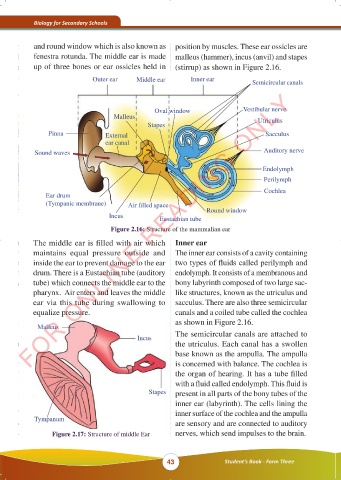
           and round window which is also known as  position by muscles. These ear ossicles are
           fenestra rotunda. The middle ear is made  malleus (hammer), incus (anvil) and stapes
           up of three bones or ear ossicles held in  (stirrup) as shown in Figure 2.16.
                             Outer ear    Middle ear       Inner ear         Semicircular canals
          FOR ONLINE READING ONLY


                                                Oval window                Vestibular nerve
                                   Malleus                                     Utriculus
                                              Stapes
                Pinna            External                                        Sacculus
                                 ear canal
            Sound waves                                                          Auditory nerve

                                                                                 Endolymph
                                                                                 Perilymph
                                                                                 Cochlea
               Ear drum
               (Tympanic membrane)      Air filled space
                                                               Round window
                                  Incus          Eustachian tube
                                   Figure 2.16: Structure of the mammalian ear

           The middle ear is filled with air which  Inner ear
           maintains equal pressure outside and  The inner ear consists of a cavity containing
           inside the ear to prevent damage to the ear  two types of fluids called perilymph and
           drum. There is a Eustachian tube (auditory  endolymph. It consists of a membranous and
           tube) which connects the middle ear to the  bony labyrinth composed of two large sac-
           pharynx.  Air enters and leaves the middle  like structures, known as the utriculus and
           ear via this tube during swallowing to  sacculus. There are also three semicircular
           equalize pressure.                         canals and a coiled tube called the cochlea
                                                      as shown in Figure 2.16.
            Malleus
                                           Incus      The semicircular canals are attached to
                                                      the utriculus. Each canal has a swollen
                                                      base known as the ampulla. The ampulla
                                                      is concerned with balance. The cochlea is
                                                      the organ of hearing. It has a tube filled
                                                      with a fluid called endolymph. This fluid is
                                              Stapes  present in all parts of the bony tubes of the
                                                      inner ear (labyrinth). The cells lining the
                                                      inner surface of the cochlea and the ampulla
           Tympanum
                                                      are sensory and are connected to auditory
                 Figure 2.17: Structure of middle Ear  nerves, which send impulses to the brain.


                                                    43               Student’s Book - Form Three


                                                                                          23/10/2025   11:52:36
     BIOLOGY FORM 3 FINAL EDITED 16.09.2025.indd   43
     BIOLOGY FORM 3 FINAL EDITED 16.09.2025.indd   43 KAMISHNA                            23/10/2025   11:52:36                     KAMISHNA

