


Page 48 - Biology_Form_3
P. 48
Biology for Secondary Schools


           The dermis has numerous blood capillaries, nerve endings, fat deposits, hair follicles
           (roots) and the inner ends of the sweat glands. The structures found in the dermis have
           different functions. For example, sweat glands produce a waste fluid called sweat. The
           evaporation of sweat cools the body. Erector muscles raise the hairs in the skin. Raised
           hair and fat help to conserve heat in the body. Sebaceous glands secrete sebum, an oily
          FOR ONLINE READING ONLY
           fluid which prevents cracking of the epidermis. The dermis also contains touch, pain,
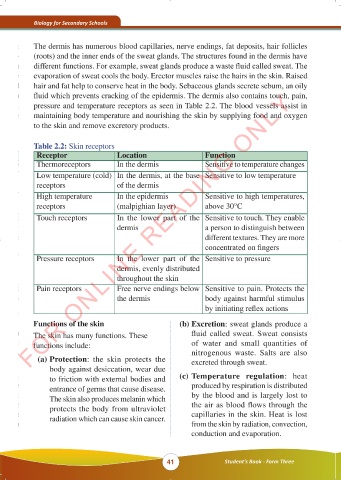
           pressure and temperature receptors as seen in Table 2.2. The blood vessels assist in
           maintaining body temperature and nourishing the skin by supplying food and oxygen
           to the skin and remove excretory products.


           Table 2.2: Skin receptors
            Receptor                Location                   Function
            Thermoreceptors         In the dermis              Sensitive to temperature changes
            Low temperature (cold)  In the dermis, at the base  Sensitive to low temperature
            receptors               of the dermis
            High temperature        In the epidermis           Sensitive to high temperatures,
            receptors               (malpighian layer)         above 30°C
            Touch receptors         In the lower part of the  Sensitive to touch. They enable
                                    dermis                     a person to distinguish between
                                                               different textures. They are more
                                                               concentrated on fingers
            Pressure receptors      In the lower part of the  Sensitive to pressure
                                    dermis, evenly distributed
                                    throughout the skin
            Pain receptors          Free nerve endings below  Sensitive to pain. Protects the
                                    the dermis                 body against harmful stimulus
                                                               by initiating reflex actions

           Functions of the skin                       (b)  Excretion: sweat glands produce a
           The skin has many functions. These              fluid called sweat. Sweat consists
           functions include:                              of water and small quantities of
                                                           nitrogenous waste. Salts are also
            (a)  Protection: the skin protects the         excreted through sweat.
                body against desiccation, wear due
                to friction with external bodies and   (c)  Temperature  regulation: heat
                entrance of germs that cause disease.      produced by respiration is distributed
                The skin also produces melanin which       by the blood and is largely lost to
                protects the body from ultraviolet         the air as blood flows through the
                radiation which can cause skin cancer.     capillaries in the skin. Heat is lost
                                                           from the skin by radiation, convection,
                                                           conduction and evaporation.


                                                    41               Student’s Book - Form Three


                                                                                          23/10/2025   11:52:35
     BIOLOGY FORM 3 FINAL EDITED 16.09.2025.indd   41
     BIOLOGY FORM 3 FINAL EDITED 16.09.2025.indd   41 KAMISHNA                            23/10/2025   11:52:35                     KAMISHNA

