


Page 47 - Biology_Form_3
P. 47
Coordination in animals


             Questions                                responds to pain, pressure, touch, heat,
             (a)  Which sense organs do you see?      and cold sensations. Structurally, the skin
             (b)  Describe the functions of the sense    consists of two main layers namely; the
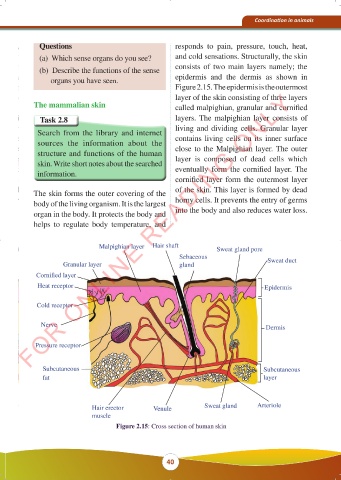
                   organs you have seen.              epidermis and the  dermis as shown in
                                                      Figure 2.15. The epidermis is the outermost
          FOR ONLINE READING ONLY
                                                      layer of the skin consisting of three layers
           The mammalian skin                         called malpighian, granular and cornified

             Task 2.8                                 layers. The malpighian layer consists of
                                                      living and dividing cells. Granular layer
            Search from the library and internet
            sources the information about the         contains living cells on its inner surface
                                                      close to the Malpighian layer. The outer
            structure and functions of the human
            skin. Write short notes about the searched   layer is composed of dead cells which
                                                      eventually  form  the  cornified  layer. The
            information.
                                                      cornified layer form the outermost layer

           The skin forms the outer covering of the   of the skin. This layer is formed by dead
           body of the living organism. It is the largest   horny cells. It prevents the entry of germs
           organ in the body. It protects the body and    into the body and also reduces water loss.
           helps to regulate body temperature, and


                               Malpighian layer  Hair shaft        Sweat gland pore
                                                       Sebaceous
                    Granular layer                     gland                      Sweat duct
            Cornified layer
            Heat receptor                                                        Epidermis


            Cold receptor

             Nerve                                                               Dermis


            Pressure receptor


              Subcutaneous                                                       Subcutaneous
              fat                                                                layer


                             Hair erector      Venule          Sweat gland     Arteriole
                             muscle
                                    Figure 2.15: Cross section of human skin


                                                   40


                                                                                          23/10/2025   11:52:35
     BIOLOGY FORM 3 FINAL EDITED 16.09.2025.indd   40
     BIOLOGY FORM 3 FINAL EDITED 16.09.2025.indd   40 KAMISHNA                            23/10/2025   11:52:35


 KAMISHNA

