


Page 134 - Mathematics_Form_3
P. 134
Circles


                2.  Measure the sizes of all the angles                 X
                                                                             R
                   formed on the circumference of a
                   circle.                                                         Y

                3.  Compare the size of each angle
          FOR ONLINE READING ONLY
                   measured in task 2 and conclude                      O

                   about the relationship between the
                                                             A                     B
                   angles.
                4.  Draw  a  similar  figure  in  your
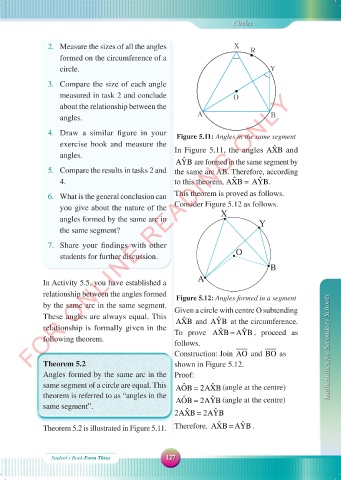
                                                      Figure 5.11: Angles in the same segment
                   exercise book and measure the
                                                                                    ˆ
                                                      In Figure 5.11, the angles AXB and
                   angles.
                                                        ˆ
                                                      AYB are formed in the same segment by
                5.  Compare the results in tasks 2 and   the same arc AB. Therefore, according
                                                                               ˆ
                                                                        ˆ
                   4.                                 to this theorem, AXB  =   AYB.
                                                      This theorem is proved as follows.
                6.  What is the general conclusion can
                                                      Consider Figure 5.12 as follows.
                   you give about the nature of the
                                                                    X
                   angles formed by the same arc in
                                                                               Y
                   the same segment?
                7.  Share  your  findings  with  other
                                                                        O
                   students for further discussion.
                                                                                   B

                                                             A
              In Activity 5.5, you have established a
              relationship between the angles formed
                                                      Figure 5.12: Angles formed in a segment
              by the same arc in the same segment.
                                                      Given a circle with centre O subtending
              These angles are always equal. This       ˆ          ˆ
                                                      AXB   and  AYB  at the circumference.
              relationship is formally given in the                ˆ       ˆ
                                                      To prove  AXB = AYB , proceed as
              following theorem.
                                                      follows.
                                                      Construction: Join  AO  and  BO as            Mathematics for Secondary Schools
              Theorem 5.2                             shown in Figure 5.12.
              Angles formed by the same arc in the  Proof:
                                                                 ˆ ˆ
                                                        ˆ
              same segment of a circle are equal. This   AOB 2ACB= AXB (angle at the centre)
              theorem is referred to as “angles in the   AOB 2ADB= AYB (angle at the centre)
                                                        ˆ
                                                                 ˆ ˆ
              same segment”.
                                                                  ˆ
                                                         ˆ
                                                      2AXB = 2AYB
                                                                   ˆ
                                                                          ˆ
              Theorem 5.2 is illustrated in Figure 5.11.  Therefore,  AXB = AYB .
                 Student\s Book Form Three         127


                                                                                          18/09/2025   09:59:39
     MATHEMATIC F3 SB.indd   127                                                          18/09/2025   09:59:39
     MATHEMATIC F3 SB.indd   127

