


Page 137 - Mathematics_Form_3
P. 137
Circles


               5.  Draw other four circles of different              Q
                   radii and repeat tasks 1 to 4.

               6.  Study carefully the results obtained
                   in task 4 and write a single statement                             B
          FOR ONLINE READING ONLY
                                                                       O
                   which summarizes your findings.
               7.  Use congruence and similarity          A
                   theorems, circle theorems, algebra,
                   and any other method of your                                  P
                   choice to prove the findings you
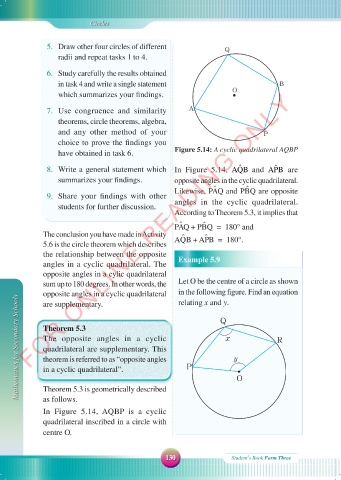
                                                      Figure 5.14: A cyclic quadrilateral AQBP
                   have obtained in task 6.
                                                                         ˆ
                                                                                    ˆ
               8.  Write a general statement which  In Figure 5.14,  AQB and  APB are

                   summarizes your findings.          opposite angles in the cyclic quadrilateral.
                                                                   ̂
                                                                            ̂
                                                      Likewise,  P A   Q  and  P B   Q  are opposite
               9.  Share  your  findings  with  other   angles in the  cyclic quadrilateral.
                   students for further discussion.
                                                      According to Theorem 5.3, it implies that
                                                        ̂
                                                               ̂
                                                        P A   Q + P B   Q  =  180°  and
              The conclusion you have made in Activity   ̂      ̂
                                                        A Q   B + A P   B  =  180° .
              5.6 is the circle theorem which describes
              the relationship between the opposite
                                                       Example 5.9
              angles in a cyclic quadrilateral. The
              opposite angles in a cylic quadrilateral
              sum up to 180 degrees. In other words, the   Let  O    be the centre of a circle as shown
              opposite angles in a cyclic quadrilateral   in the following figure. Find an equation
      Mathematics for Secondary Schools  Theorem 5.3     P          Q x  y O         R
                                                       relating x   and  y.
              are supplementary.


              The opposite angles in a  cyclic
              quadrilateral are supplementary. This
              theorem is referred to as “opposite angles
              in a cyclic quadrilateral”.


              Theorem 5.3 is geometrically described
              as follows.
              In Figure 5.14,  AQBP is a  cyclic
              quadrilateral inscribed in a circle with
              centre O.


                                                   130                 Student\s Book Form Three


                                                                                          18/09/2025   09:59:41
     MATHEMATIC F3 SB.indd   130
     MATHEMATIC F3 SB.indd   130                                                          18/09/2025   09:59:41

