


Page 140 - Mathematics_Form_3
P. 140
Circles


                2.  Label the vertices of the cyclic  Theorem 5.4 is described geometrically
                   quadrilateral formed in task 1.    as follows.

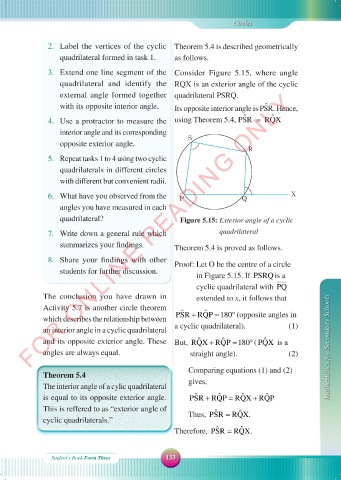
                3.  Extend one line segment of the  Consider Figure 5.15, where angle
                   quadrilateral and identify the  RQX is an exterior angle of the cyclic
          FOR ONLINE READING ONLY
                   external angle formed together  quadrilateral PSRQ.
                   with its opposite interior angle.  Its opposite interior angle is  P S   R . Hence,
                                                                                  ̂
                                                                            ̂
                                                                                    ̂
                4.  Use a protractor to measure the   using Theorem 5.4, P S   R  =  R Q   X

                   interior angle and its corresponding
                   opposite exterior angle.               S
                                                                            R
                5.  Repeat tasks 1 to 4 using two cyclic
                   quadrilaterals in different circles
                   with different but convenient radii.

                6.  What have you observed from the    P                  Q              X
                   angles you have measured in each
                   quadrilateral?                      Figure 5.15:  Exterior angle of a cyclic

                7.  Write down a general rule which                quadrilateral
                   summarizes your findings.          Theorem 5.4 is proved as follows.

                8.  Share  your  findings  with  other   Proof:  Let O be the centre of a circle
                   students for further discussion.         in Figure 5.15. If  PSRQ is a

                                                            cyclic quadrilateral with PQ
              The  conclusion  you  have  drawn  in         extended to x, it follows that
              Activity 5.7 is another circle theorem    ˆ      ˆ
              which describes the relationship between   PSR RQP 180+  =  °  (opposite angles in
              an interior angle in a cyclic quadrilateral   a cyclic quadrilateral).    (1)
                                                                                 ˆ
              and its opposite exterior angle. These  But,  RQX RQP 180+  ˆ  ˆ  =  °  ( PQX  is a
              angles are always equal.                    straight angle).              (2)         Mathematics for Secondary Schools

                                                              Comparing equations (1) and (2)
              Theorem 5.4
                                                          gives,
              The interior angle of a cylic quadrilateral
              is equal to its opposite exterior angle.          PSR RQP+  ˆ  ˆ  =  RQX RQP+  ˆ  ˆ

              This is reffered to as “exterior angle of          Thus,  PSR =  RQX.
                                                                         ˆ
                                                                  ˆ
              cyclic quadrilaterals.”
                                                                          ˆ
                                                                  ˆ
                                                      Therefore,  PSR = RQX.

                 Student\s Book Form Three         133


                                                                                          18/09/2025   09:59:43
     MATHEMATIC F3 SB.indd   133                                                          18/09/2025   09:59:43
     MATHEMATIC F3 SB.indd   133

