


Page 156 - Mathematics_Form_3
P. 156
Circles


               Solution                                From the figure, it follows that
               (a) From the figure, it follows that    AXBX×     =  CXDX×   (intersecting
                   AEBE×    =  CEDE×   (intersecting                          chords)
                   chords). Thus,                      Thus,
          FOR ONLINE READING ONLY
                   8cm x×=   6cm 4cm×
                          24cm 2                       4cm 3cm×   =  2cm DX×
                      x
                   ⇒=                                  ⇒  12cm =  2  2cm DX×
                           8cm
                       = 3cm.                          ⇒  DX =  12cm  2
                   Therefore, x = 3 cm.                          2cm
               (b) From the figure, it follows that                =  6cm

                   UW XW×     =  VW YW×                In  BXD∆  , apply Pythagoras theorem
                   (intersecting secants). Thus,           2     2      2

                   8cm 6cm 12cm x×  =  ×               BD =   BX +   DX
                                                           2
                                                       BD =
                            2
                          48cm = 12cm x×               Thus,  3 +  2  6 =  2 2  45  2
                                                           2
                                     2
                                                           2
                                                                     3 5 cm
                                                                45 =
                                                       BD =
                            x =  48cm                  BD =   (3cm) +  (6cm)
                                    12cm                    =  45cm 2
                                         4cm=
                   Therefore,  x =  4cm.                  BD =  45 cm
                                                                = 3 5 cm
               Example 5.21
                                                       In  AXC∆  , apply Pythagoras theorem
               Two chords  AB and  CD intersect            2      2     2

               at right angles at X. If  CX =  2 cm,   AC =   AX +   CX
                                                           2
                                                       AC =
                AX =  4 cm, and  BX = 3 cm, find  the   Thus,  4 +  2  2 =  2  20
                                                           2        2        2
                                                           2
                        AC                             AC =   (4cm) +  (2cm)
                                                       BD =
                                                                     2 5 cm
                                                                20 =
               value of     .
                        BD                                  =  20cm 2
               Solution
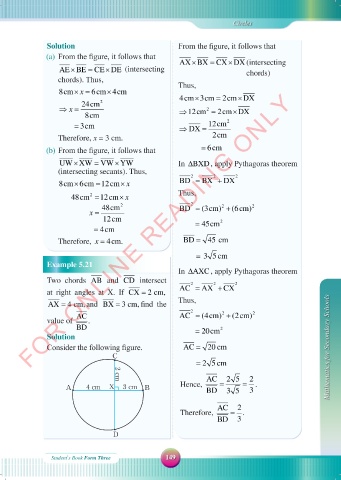
               Consider the following figure.             AC =  20 cm                               Mathematics for Secondary Schools
                                   C
                                                                =  2 5 cm
                                                               AC     2 5   2
                                                       Hence,      =      =   .
                                    2 cm
                     A     4 cm   X   3 cm   B                 BD     35    3
                                                                         2 5
                                                            AC    2 AC 5  2     2
                                                                       = .
                                                       Therefore,  =   =      =  .
                                                            BD    35     3      3
                                                                         35
                                                                   BD
                                   D

                 Student\s Book Form Three         149


                                                                                          18/09/2025   09:59:51
     MATHEMATIC F3 SB.indd   149
     MATHEMATIC F3 SB.indd   149                                                          18/09/2025   09:59:51

