


Page 159 - Mathematics_Form_3
P. 159
Circles


                ˆ
              TQO TPO=90=  ˆ  °                            x + z  =  9                  (3)
              (radius is perpendicular to the tangent)   Subtracting equation (2) from

              OT =  OT (common side of both              equation (1) gives,


                 FOR ONLINE READING ONLY
                        triangles)                           x − z = 1                  (4)
              Thus,  QOT∆  ≡∆  POT (RHS postulate)       Adding equations (3) and (4) gives,
                                                                 2x = 10
              Therefore,  TP =  TQ (Definition  of          ⇒  x = 5

              congruent triangles). This proves that
              the tangents from a common external        Substituting  x = 5  in equations (1)
              point are equal.                           and (3), gives,
                                                           y = 3  and   z = 4 .
               Example 5.22
                                                         Therefore,  x = 5 cm,   y = 3 cm , and
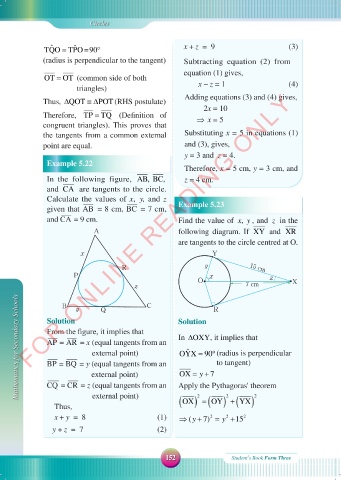
               In the following figure,  AB, BC,         z = 4 cm.
               and  CA  are tangents to the circle.
               Calculate the values of  x,  y, and  z
               given that    ‾ AB   = 8 cm,     ‾ BC   = 7 cm,    Example 5.23

               and    ‾ CA   = 9 cm.                   Find the value of  ,x y , and  z  in the

                             A                         following diagram.  If  XY  and  XR
                                                       are tangents to the circle centred at O.
                         x                                       Y

                                      R                        y             15 cm
                       P                                        x                  z
                                                             O                            X X
                                          z  C                    R        7 cm
      Mathematics for Secondary Schools  Solution  external point)   Solution  , it implies that
                    B
                        y
                                Q

               From the figure, it implies that
                                                       In  OXY∆
                  ‾    =   ‾ AR   = x   (equal tangents from an
               AP

                                                         ˆ
                                                                 °  (radius is perpendicular
                                                       OYX 90=
                             external point)
                                                                   to tangent)
                  ‾    =   ‾ BQ   = y   (equal tangents from an
               BP
                                                             y
                                                                 7
                                                       OX = +
                  ‾    =   ‾ CR   = z   (equal tangents from an
               CQ

                                                       ( ) ( ) ( )
                                                                     2
                                                                              2
                                                             2
                                                                 OY +
                                                                         YX
                                                        OX
                                                              =
                 Thus,       external point)           Apply the Pythagoras' theorem
                 x + y  =  8                     (1)   ⇒  (y +  7) =  2  y +  2  15 2

                 y + z  =  7                     (2)

                                                   152                 Student\s Book Form Three
                                                                                          18/09/2025   09:59:52
     MATHEMATIC F3 SB.indd   152                                                          18/09/2025   09:59:52
     MATHEMATIC F3 SB.indd   152

