


Page 162 - Mathematics_Form_3
P. 162
Circles


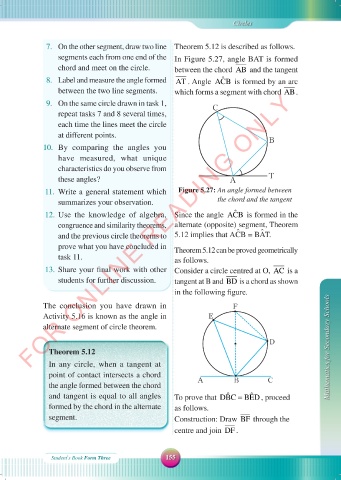
               7.  On the other segment, draw two line  Theorem 5.12 is described as follows.
                   segments each from one end of the   In Figure 5.27, angle BAT is formed
                   chord and meet on the circle.      between the chord AB and the tangent
                                                                    ˆ
               8.  Label and measure the angle formed   AT . Angle  ACB is formed by an arc
          FOR ONLINE READING ONLY
                   between the two line segments.     which forms a segment with chord AB.
               9.  On the same circle drawn in task 1,
                                                                 C
                   repeat tasks 7 and 8 several times,
                   each time the lines meet the circle
                   at different points.
                                                                                  B
              10.  By comparing the angles you
                   have measured, what unique
                   characteristics do you observe from
                                                                                  T
                   these angles?                                      A

               11.  Write a general statement which    Figure 5.27:  An angle formed between
                                                                   the chord and the tangent
                   summarizes your observation.
                                                                        ˆ
               12.  Use the knowledge of algebra,  Since the angle  ACB is formed in the
                   congruence and similarity theorems,   alternate (opposite) segment, Theorem
                                                                                 ̂
                                                                          ̂
                   and the previous circle theorems to   5.12 implies that  A C   B = B A   T.
                   prove what you have concluded in   Theorem 5.12 can be proved geometrically
                   task 11.                           as follows.
               13.  Share your final work with other  Consider a circle centred at O, AC is a
                   students for further discussion.   tangent at B and BD is a chord as shown
                                                      in the following figure.

              The  conclusion  you  have  drawn  in                    F
              Activity 5.16 is known as the angle in            E
              alternate segment of circle theorem.

                                                                                  D D
                Theorem 5.12                                                                        Mathematics for Secondary Schools
                In any  circle, when a tangent at
                point of contact intersects a chord
                                                             A          B         C
                the angle formed between the chord
                                                                      ˆ
                                                                             ˆ
                and tangent is equal to all angles    To prove that  DBC =  BED, proceed
                formed by the chord in the alternate   as follows.
                segment.                              Construction: Draw  BF through the

                                                      centre and join DF .


                 Student\s Book Form Three         155


                                                                                          18/09/2025   09:59:54
     MATHEMATIC F3 SB.indd   155                                                          18/09/2025   09:59:54
     MATHEMATIC F3 SB.indd   155

