


Page 36 - Mathematics_Form_3
P. 36
Functions

              Chapter Two


                                                                        Functions
          FOR ONLINE READING ONLY


                 Introduction

                 A function is a special type of a relationship between the elements of two sets A
                 and B. It provides a way of representing real world situations mathematically,
                 where a specific input yields a corresponding specific output. A function can
                 be compared to a machine that produces a unique output based on one or
                 more inputs. In this chapter, you will learn the concept of a function, types
                 of functions, representing functions pictorially, identifying functions among
                 relations, drawing graphs of functions, stating the domain and range of
                 functions, and finding inverse functions. The competencies developed in
                 this chapter will enable you to represent some real life activities in terms of
                 functions, such as finding circumferences and areas of large objects, recording
                 quantities of things in related measuring units, analysing supply and demand
                 in terms of prices of goods, among many other applications.


                           Think
                           Scientific formulas, programming languages,  Artificial Intelligence
                           (AI), internet, without the knowledge of functions.

              Concept of a function
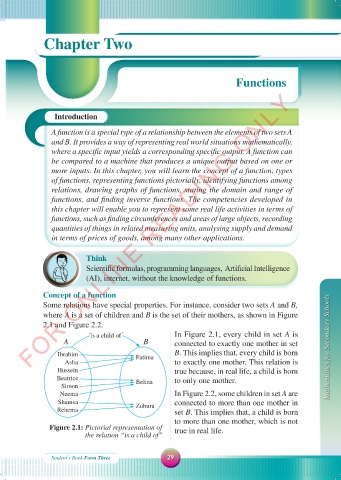
              Some relations have special properties. For instance, consider two sets A and B,
              where A is a set of children and B is the set of their mothers, as shown in Figure
              2.1 and Figure 2.2.
                            ‘ is a child of ’         In Figure 2.1, every child in set A is
                    A                       B         connected to exactly one mother in set
                  Ibrahim                 Fatima      B. This implies that, every child is born     Mathematics for Secondary Schools
                     Asha                             to exactly one mother. This relation is
                  Hussein                             true because, in real life, a child is born
                  Beatrice                Belina      to only one mother.
                    Simon
                   Neema                              In Figure 2.2, some children in set A are
                   Shamsa                 Zuhura      connected to more than one mother in
                  Rehema                              set B. This implies that, a child is born
                                                      to more than one mother, which is not
                Figure 2.1:  Pictorial representation of    true in real life.
                           the relation “is a child of”


                 Student\s Book Form Three          29


                                                                                          18/09/2025   09:58:49
     MATHEMATIC F3 SB.indd   29                                                           18/09/2025   09:58:49
     MATHEMATIC F3 SB.indd   29

