


Page 47 - Mathematics_Form_3
P. 47
Functions


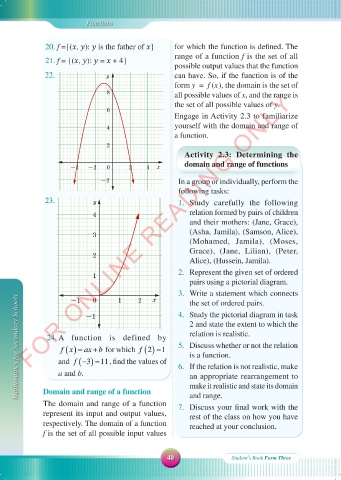
               20. f ={(  ,   ):    is the father of   }  for which the function is defined. The
               21. f = {(  ,   ):    =    + 4}        range of a function f is the set of all
                                                      possible output values that the function
               22.               y                    can have. So, if the function is of the
                                                      form  y  =  f (x ),  the domain is the set of
          FOR ONLINE READING ONLY
                                 8                    all possible values of x, and the range is
                                                      the set of all possible values of y.
                                 6
                                                      Engage in Activity 2.3 to familiarize

                                 4                    yourself with the domain and range of
                                                      a function.
                                 2
                                                         Activity 2.3: Determining the
                                                         domain and range of functions
                      -4    -2   0      2    4  x

                               -2                      In a group or individually, perform the
                                                       following tasks:
               23.           y                         1.  Study  carefully  the  following

                             4                            relation formed by pairs of children
                                                          and their mothers: (Jane, Grace),
                                                          (Asha, Jamila), (Samson, Alice),
                             3
                                                          (Mohamed, Jamila), (Moses,
                                                          Grace), (Jane, Lilian), (Peter,
                             2
                                                          Alice), (Hussein, Jamila).
                                                       2.  Represent the given set of ordered
                             1
                                                          pairs using a pictorial diagram.
                                                       3.  Write a statement which connects
      Mathematics for Secondary Schools  24.  A function is defined by   5.  Discuss whether or not the relation
                                               x
                                           2
                             0
                                     1
                      -1
                                                          the set of ordered pairs.
                                                       4.  Study the pictorial diagram in task
                           -1
                                                          2 and state the extent to which the
                                                          relation is realistic.
                          ax b+  for which  ( ) 2f
                                                =
                   f
                     ( ) x =
                                                  1
                                                          is a function.
                   and  ( ) 3f −
                              =
                               11, find the values of
                                                       6.  If the relation is not realistic, make
                   a and b.
                                                          make it realistic and state its domain
              Domain and range of a function
                                                          and range.
              The domain and range of a function          an appropriate rearrangement to
                                                       7.  Discuss your final work with the
              represent its input and output values,
                                                          rest of the class on how you have
              respectively. The domain of a function      reached at your conclusion.
              f is the set of all possible input values
                                                    40                 Student\s Book Form Three


                                                                                          18/09/2025   09:58:54
     MATHEMATIC F3 SB.indd   40                                                           18/09/2025   09:58:54
     MATHEMATIC F3 SB.indd   40

