


Page 49 - Mathematics_Form_3
P. 49
Functions


               6.   h (t )   =   t     + 2t + 3                      y
                            2
               7.   f (t )   =  2 −  t                   Line 1               Line 2
                                2
                                                        f(x)=mx+c            f(x)=mx+c
               8.   g (x )   =  3 + 2x −  x                m<0                m>0
                                      2
                             1
          FOR ONLINE READING ONLY

               9.   f (x )  =                                              f(x)=c   Line 3
                           x + 4                                             m=0
               10.   g (x )   =  − (1 −  x     )
                                   2
               11.   f  (  ) = 4
                                                                                       x
                           3x − 4
                     () =
               12.   fx
                            x − 3
                                3
                     () = +
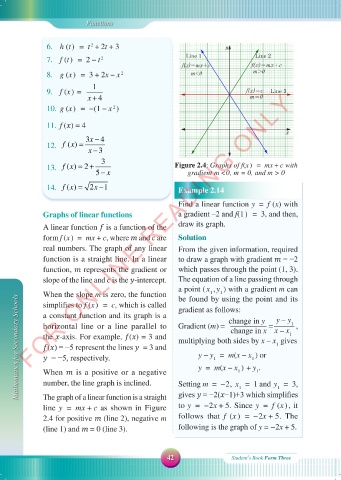
               13.   fx    2                          Figure 2.4: Graphs of  f(x )   =  mx + c  with
                              5 x−                        gradient m <0, m = 0, and m > 0
               14.  fx =    2x − 1                     Example 2.14
                     ()

                                                       Find a linear function  y  =  f (x)  with
              Graphs of linear functions               a gradient ‒2 and  f(1 )   =  3,  and then,
              A linear function    is a function of the   draw its graph.
              form  f (x )  =  mx + c,  where    and    are   Solution
              real numbers. The graph of any linear    From the given information, required
              function is a straight line. In a linear    to draw a graph with gradient    = −2
              function,    represents the gradient or   which passes through the point (1, 3).
              slope of the line and    is the   -intercept.   The equation of a line passing through
                                                       a point  (  x     ,  y     )  with a gradient m can
              When the slope m is zero, the function   be found by using the point and its
                                                                    1
                                                                 1
      Mathematics for Secondary Schools  horizontal line or a line parallel to   Gradient (m) =    change in y      =    _   ,
              simplifies to  f (x )   =  c,  which is called
                                                       gradient as follows:
              a constant function and its graph is a

                                                                                     y – y
                                                                       _
                                                                                         1

                                                                       change in x x – x
              the   -axis. For example,   (  ) = 3 and
                                                                                         1
                                                       multiplying both sides by x – x  gives
                                                                                     1
                (  ) = −5 represent the lines     = 3 and
                                                             y −  y      =  m(x −  x     )  or
                  = −5, respectively.
                                                                  1
                                                                             1
                                                             y  =  m(x −  x     )  +  y     .
              When    is a positive or a negative
                                                                         1
                                                                               1
              number, the line graph is inclined.
                                                                         1
                                                                                     1
                                                       gives    = −2(  −1)+3 which simplifies
              The graph of a linear function is a straight
                                                       to  y  =  − 2x + 5.  Since  y  =  f (x ) ,  it
              line  y  =  mx + c  as shown in Figure   Setting  m  =  − 2,    x      =  1 and   y      =  3,
              2.4 for positive    (line 2), negative m   follows that   f  (x )   =  − 2x + 5.  The
              (line 1) and    = 0 (line 3).            following is the graph of  y = − 2x + 5.
                                                    42                 Student\s Book Form Three
                                                                                          18/09/2025   09:58:55
     MATHEMATIC F3 SB.indd   42
     MATHEMATIC F3 SB.indd   42                                                           18/09/2025   09:58:55

