


Page 48 - Biology Form Two
P. 48
Biology for Secondary Schools


          FOR ONLINE READING ONLY
                           Mouth                                  Oral cavity

                           Tongue                                 Pharynx
                                                                  Epiglottis

                                                                  Oesophagus

                                                                  Trachea


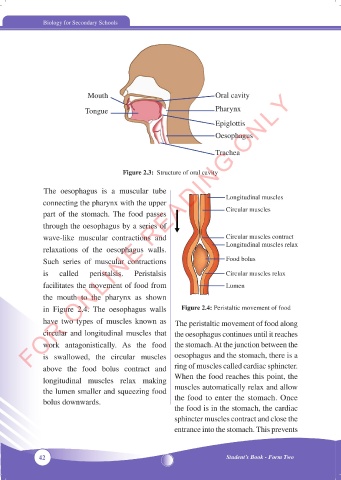
                                      Figure 2.3:  Structure of oral cavity

              The oesophagus is a muscular tube
              connecting the pharynx with the upper                  Longitudinal muscles
              part of the stomach. The food passes                   Circular muscles

              through the oesophagus by a series of
              wave-like  muscular  contractions  and                 Circular muscles contract
              relaxations  of the oesophagus walls.                  Longitudinal muscles relax
              Such  series  of  muscular  contractions               Food bolus

              is   called   peristalsis.  Peristalsis                Circular muscles relax
              facilitates the movement of food from                  Lumen
              the mouth to the pharynx as shown
              in Figure 2.4.  The oesophagus walls      Figure 2.4: Peristaltic movement of food

              have  two types of muscles known as     The peristaltic movement of food along
              circular and longitudinal muscles that  the oesophagus continues until it reaches
              work antagonistically.  As the  food  the stomach. At the junction between the
              is  swallowed,  the  circular  muscles   oesophagus and the stomach, there is a

              above the food bolus contract  and      ring of muscles called cardiac sphincter.
              longitudinal  muscles relax making      When the food reaches this point, the
              the lumen smaller and squeezing food    muscles automatically relax and allow
              bolus downwards.                        the food to enter the stomach. Once
                                                      the food is in the stomach, the cardiac
                                                      sphincter muscles contract and close the
                                                      entrance into the stomach. This prevents


             42                                                      Student’s Book - Form Two


                                                                                          05/10/2024   15:36:22
     BIOLOGY FORM 2 NEW.indd   42                                                         05/10/2024   15:36:22
     BIOLOGY FORM 2 NEW.indd   42

