


Page 53 - Biology Form Two
P. 53
Biology for Secondary Schools


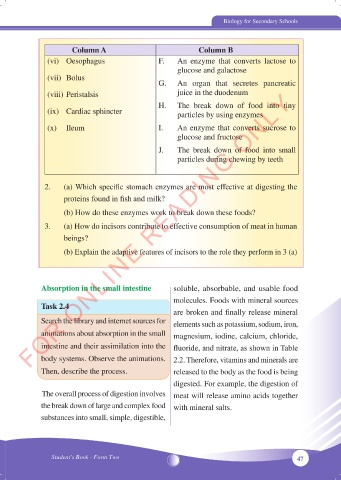
                       Column A                              Column B
               (vi)  Oesophagus                  F.    An enzyme that converts lactose to
                                                       glucose and galactose
               (vii)  Bolus
                                                 G.    An organ that secretes pancreatic
          FOR ONLINE READING ONLY
               (viii) Peristalsis                      juice in the duodenum
                                                 H.    The break down of food into tiny
               (ix)  Cardiac sphincter                 particles by using enzymes

               (x)  Ileum                        I.    An enzyme that converts sucrose to
                                                       glucose and fructose
                                                 J.    The break down  of food into small
                                                       particles during chewing by teeth


               2.   (a) Which specific stomach enzymes are most effective at digesting the
                    proteins found in fish and milk?

                    (b) How do these enzymes work to break down these foods?

               3.   (a) How do incisors contribute to effective consumption of meat in human
                    beings?

                    (b) Explain the adaptive features of incisors to the role they perform in 3 (a)


             Absorption in the small intestine       soluble, absorbable, and usable food

                                                     molecules. Foods with mineral sources
             Task 2.4
                                                     are broken and finally release mineral
             Search the library and internet sources for   elements such as potassium, sodium, iron,
             animations about absorption in the small   magnesium, iodine, calcium, chloride,
             intestine and their assimilation into the   fluoride, and nitrate, as shown in Table

             body systems. Observe the animations.   2.2. Therefore, vitamins and minerals are
             Then, describe the process.             released to the body as the food is being

                                                     digested. For example, the digestion of
              The overall process of digestion involves   meat will release amino acids together

             the break down of large and complex food   with mineral salts.
             substances into small, simple, digestible,


                 Student’s Book - Form Two                                                 47


                                                                                          05/10/2024   15:36:23
     BIOLOGY FORM 2 NEW.indd   47                                                         05/10/2024   15:36:23
     BIOLOGY FORM 2 NEW.indd   47

