


Page 57 - Biology Form Two
P. 57
Biology for Secondary Schools


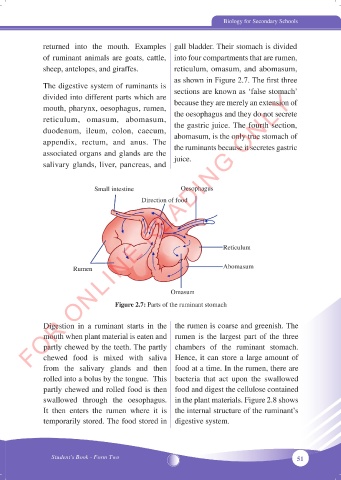
              returned  into the  mouth.  Examples  gall bladder. Their stomach is divided
              of ruminant animals are goats, cattle,  into four compartments that are rumen,
              sheep, antelopes, and giraffes.         reticulum, omasum, and abomasum,
                                                      as shown in Figure 2.7. The first three
              The digestive system of ruminants is
          FOR ONLINE READING ONLY
              divided into different parts which are   sections are known as ‘false stomach’
              mouth, pharynx, oesophagus, rumen,      because they are merely an extension of

              reticulum,  omasum,  abomasum,          the oesophagus and they do not secrete
              duodenum,  ileum, colon, caecum,        the gastric juice. The fourth section,
              appendix, rectum, and anus.  The        abomasum, is the only true stomach of
              associated organs and glands are the    the ruminants because it secretes gastric
              salivary glands, liver, pancreas, and   juice.


                              Small intestine           Oesophagus
                                            Direction of food


                                                                     Reticulum


                       Rumen                                         Abomasum


                                                     Omasum

                                    Figure 2.7: Parts of the ruminant stomach

              Digestion in a  ruminant starts in the  the rumen is coarse and greenish. The
              mouth when plant material is eaten and  rumen is the largest part of the three
              partly chewed by the teeth. The partly  chambers  of the  ruminant stomach.
              chewed food is mixed  with saliva  Hence, it can store a large amount of
              from the salivary glands and then  food at a time. In the rumen, there are
              rolled into a bolus by the tongue.  This  bacteria  that act upon the swallowed
              partly chewed and rolled food is then  food and digest the cellulose contained
              swallowed through the oesophagus.  in the plant materials. Figure 2.8 shows
              It then enters the  rumen  where it  is  the internal structure of the ruminant’s
              temporarily stored. The food stored in  digestive system.


                 Student’s Book - Form Two                                                 51


                                                                                          05/10/2024   15:36:23
     BIOLOGY FORM 2 NEW.indd   51                                                         05/10/2024   15:36:23
     BIOLOGY FORM 2 NEW.indd   51

