


Page 10 - Chemistry_Form_2
P. 10
Chemistry
                                                                           for Secondary Schools


              These modifications include the following:
              1.  Atoms can be either created or destroyed by means of nuclear reactions.
                   The atom can change form through special  processes such as nuclear
                   fusion (combining the atomic nuclei) or nuclear fission (splitting the atomic
                   nucleus). For example, an atom of uranium-235 can be split into two separate
          FOR ONLINE READING ONLY
                   atoms.
              2.  Some elements have atoms of more than one kind which differ slightly in
                   mass. Such atoms are called isotopes. For example, carbon has three isotopes
                   known as carbon-12, carbon-13, and carbon-14.

              3.  An atom is made up of smaller sub-atomic particles called protons, neutrons,
                   and electrons.
              4.  Atoms  of  different  elements  may  chemically  combine  in  many  different
                   ratios to form compounds.
              The modern atomic theory builds on Dalton’s original ideas by recognising sub-
              atomic  particles,  isotopes, and nuclear  reactions  while retaining  the ideas  of
              chemical combinations and reactions. Dalton’s discovery thus helped scientists
              understand chemical reactions and how substances combine.

              Sub-atomic particles

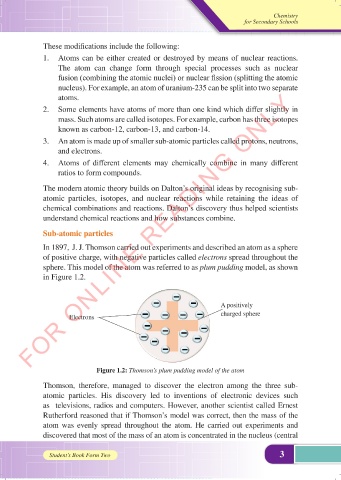
              In 1897,  J. J. Thomson carried out experiments and described an atom as a sphere
              of positive charge, with negative particles called electrons spread throughout the
              sphere. This model of the atom was referred to as plum pudding model, as shown
              in Figure 1.2.


                                                                    A positively
                      Electrons                                     charged sphere


                              Figure 1.2: Thomson’s plum pudding model of the atom

              Thomson, therefore, managed to discover the electron among the three sub-
              atomic particles. His discovery led to inventions of electronic devices such
              as  televisions, radios and computers. However, another scientist called Ernest
              Rutherford reasoned that if Thomson’s model was correct, then the mass of the
              atom was evenly spread throughout the atom. He carried out experiments and
              discovered that most of the mass of an atom is concentrated in the nucleus (central


                Student’s Book Form Two                                               3


                                                                                          01/08/2025   11:20:50
     CHEMISTRY FORM TWO NEW 2025 DUMMY.indd   3                                           01/08/2025   11:20:50
     CHEMISTRY FORM TWO NEW 2025 DUMMY.indd   3

