


Page 11 - Chemistry_Form_2
P. 11
Chemistry
              for Secondary Schools


              core) of the atom. Within the nucleus, there are positively charged particles called
              protons. This was the second sub-atomic particle to be discovered. Rutherford’s
              discovery helped scientists discover nuclear energy used to produce electricity
              and in radiotherapy.

          FOR ONLINE READING ONLY
              Rutherford’s findings are summarised as follows:
              1.    Protons, the positively charged particles  of an atom, are located in the
                    nucleus.
              2.    Most of the mass of the atom is located in the nucleus.

              3.    The nucleus has a relatively smaller volume compared to the whole atom.
              4.    Electrons have very small masses compared to the protons.
              5.    Most of the space in an atom is empty.

              6.    Electrons  are  the  negatively  charged  particles  in  an atom. They  move
                    around the nucleus in orbits.

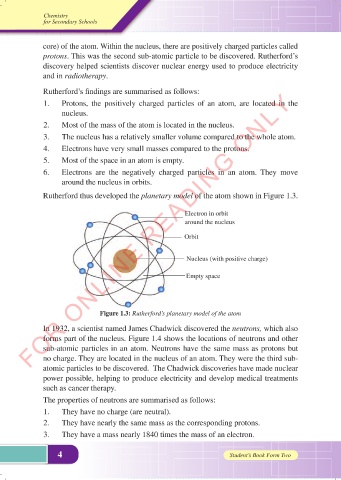
              Rutherford thus developed the planetary model of the atom shown in Figure 1.3.

                                                         Electron in orbit
                                                         around the nucleus

                                                         Orbit


                                                         Nucleus (with positive charge)

                                                         Empty space


                               Figure 1.3: Rutherford’s planetary model of the atom

              In 1932, a scientist named James Chadwick discovered the neutrons, which also
              forms part of the nucleus. Figure 1.4 shows the locations of neutrons and other
              sub-atomic particles in an atom. Neutrons have the same mass as protons but
              no charge. They are located in the nucleus of an atom. They were the third sub-
              atomic particles to be discovered.  The Chadwick discoveries have made nuclear
              power possible, helping to produce electricity and develop medical treatments
              such as cancer therapy.
              The properties of neutrons are summarised as follows:

              1.    They have no charge (are neutral).
              2.    They have nearly the same mass as the corresponding protons.
              3.    They have a mass nearly 1840 times the mass of an electron.


                  4                                                   Student’s Book Form Two


                                                                                          01/08/2025   11:20:50
     CHEMISTRY FORM TWO NEW 2025 DUMMY.indd   4
     CHEMISTRY FORM TWO NEW 2025 DUMMY.indd   4                                           01/08/2025   11:20:50

