


Page 18 - Chemistry_Form_2
P. 18
Chemistry
                                                                           for Secondary Schools


              It is also possible to calculate the number of neutrons and number of electrons of
              an atom if its mass number and atomic number are given.


                 Example 1.1
          FOR ONLINE READING ONLY
              Atom Q has a mass number of 49 and an atomic number of 24. Calculate the
              number of neutrons and the number of electrons in atom Q.

              Solution
              Mass number = 49; atomic number = 24

              (a)   Neutron number = mass number – atomic number = 49 – 24 = 25

              (b)  Number of electrons = number of protons = atomic number = 24


              Note:   For the mass number with fractions, such as chlorine (35.5), calculating
                     the number of neutrons and electrons involves only a whole number. In
                     this case, for chlorine, 35 is used.


              Nuclide notation

              Atoms of different elements can be represented by chemical symbols that indicate
              their respective atomic numbers and mass numbers. Using an arbitrary element
              X, the mass number (A) is placed on its upper left end, while its atomic number
                                                                                       A
              (Z) is placed on the lower left end. Thus,  element  X  is represented as  X .
                                                                                       Z
              This is known as the nuclide notation. The following are examples of nuclide
              representations of different atoms:
                                            1
                            (i)    Hydrogen  H           (ii)   Boron   B
                                                                     11
                                            1                         5
                            (iii)  Nitrogen  14 N         (iv)  Oxygen    O
                                                                       16
                                           7                            8
              With this information, it is possible to deduce the number
              of neutrons and electrons in the atom, and to write the
              electronic  configuration.  For  example,  in  the  oxygen
              atom, the mass number is 16 and the atomic number is 8.
              Therefore, the number of electrons is 8 and the number
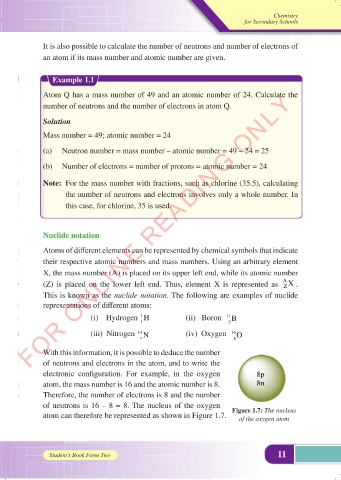
              of neutrons is 16 – 8 = 8. The nucleus of the oxygen
              atom can therefore be represented as shown in Figure 1.7.   Figure 1.7: The nucleus
                                                                         of the oxygen atom


                Student’s Book Form Two                                              11


                                                                                          01/08/2025   11:20:51
     CHEMISTRY FORM TWO NEW 2025 DUMMY.indd   11                                          01/08/2025   11:20:51
     CHEMISTRY FORM TWO NEW 2025 DUMMY.indd   11

