


Page 44 - Chemistry_Form_2
P. 44
Chemistry
                                                                           for Secondary Schools


              Procedure
              1.  Fill three beakers halfway with water.
              2.  Add a few drops of phenolphthalein or universal indicator to each beaker.

              3.  Using forceps, carefully drop a small piece of lithium into the first beaker and
          FOR ONLINE READING ONLY
                  observe the reaction.
              4.  Repeat Step 3 for sodium and potassium in separate beakers.
              5.  Record observations for each metal, focusing on  the rate of reaction, colour
                  change (due to the indicator), production of gas and sound.
              6.  Clean up all the apparatus safely under the supervision of the teacher.

              Questions
              1.  Which element was the fastest to react with water?

              2.  How did the colour of water change and what did it indicate?
              3.  What trend did you observe in the reactivity of those elements down the
                  group?
              4.  How does this experiment support the idea of periodic classification?


              Group II: Alkaline earth metals

              Group II consists of elements such as beryllium (Be), magnesium (Mg), calcium
              (Ca), strontium (Sr), barium (Ba), and radium (Ra) as shown in Table 2.7. The data
              from this table show that the physical and chemical properties of these elements
              generally increase or decrease down the group. These elements have two electrons
              in their outermost shells.

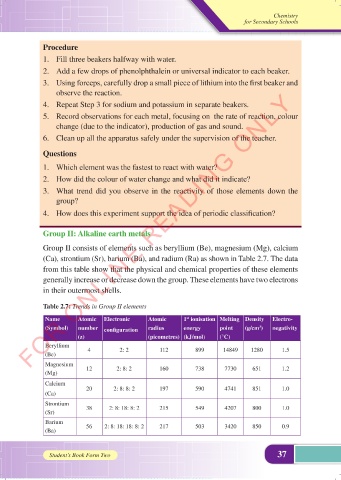
              Table 2.7: Trends in Group II elements

               Name      Atomic   Electronic   Atomic    1  ionisation  Melting  Density   Electro-
                                                         st
               (Symbol)  number   configuration  radius   energy         point   (g/cm )  negativity
                                                                               3
                         (z)                  (picometres) (kJ/mol)  (°C)
               Beryllium
               (Be)         4        2: 2        112        899     14849    1280     1.5
               Magnesium   12       2: 8: 2      160        738      7730    651      1.2
               (Mg)
               Calcium     20      2: 8: 8: 2    197        590      4741    851      1.0
               (Ca)
               Strontium
               (Sr)        38     2: 8: 18: 8: 2  215       549      4207    800      1.0
               Barium      56    2: 8: 18: 18: 8: 2  217    503      3420    850      0.9
               (Ba)


                Student’s Book Form Two                                              37


                                                                                          01/08/2025   11:20:53
     CHEMISTRY FORM TWO NEW 2025 DUMMY.indd   37                                          01/08/2025   11:20:53
     CHEMISTRY FORM TWO NEW 2025 DUMMY.indd   37

