


Page 42 - Chemistry_Form_2
P. 42
Chemistry
                                                                           for Secondary Schools


              Group II (alkaline  earth  metals)  are  highly  reactive  metals,  while  Group VII
              (halogens)  consists of reactive  non-metals.  Their  physical  properties,  such
              as atomic  radius, ionisation  energy, density, and melting  points, exhibit  clear
              trends  within  each  group,  as  shown in  Tables  2.6  and  2.7.  Chemically,  they
              differ in reactivity and electronegativity, reflecting variations in their electronic
          FOR ONLINE READING ONLY
              configurations. Understanding these properties provides valuable insights into
              their behaviour and applications in chemistry and other fields.

              Group I: Alkali metals
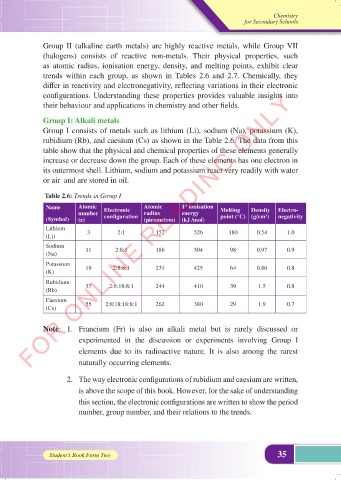
              Group I consists of metals such as lithium (Li), sodium (Na), potassium (K),
              rubidium (Rb), and caesium (Cs) as shown in the Table 2.6. The data from this
              table show that the physical and chemical properties of these elements generally
              increase or decrease down the group. Each of these elements has one electron in
              its outermost shell. Lithium, sodium and potassium react very readily with water
              or air  and are stored in oil.

               Table 2.6: Trends in Group I
               Name      Atomic   Electronic   Atomic   1  ionisation   Melting   Density   Electro-
                                                         st
                         number              radius     energy                   3
               (Symbol)  (z)    configuration  (picometres)  (kJ /mol)  point (°C) (g/cm )  negativity
               Lithium     3         2:1        152         526       180      0.54     1.0
               (Li)
               Sodium      11       2:8:1       186         504        98      0.97     0.9
               (Na)
               Potassium   19      2:8:8:1      231         425        64      0.86     0.8
               (K)
               Rubidium    37     2:8:18:8:1    244         410        39      1.5      0.8
               (Rb)
               Caesium     55    2:8:18:18:8:1  262         380        29      1.9      0.7
               (Cs)


              Note:  1.  Francium (Fr) is also an alkali  metal  but is rarely discussed or
                         experimented in the discussion or experiments involving Group I
                         elements  due  to  its  radioactive  nature.  It  is  also  among  the  rarest
                         naturally occurring elements.


                      2.    The way electronic configurations of rubidium and caesium are written,
                         is above the scope of this book. However, for the sake of understanding
                         this section, the electronic configurations are written to show the period
                         number, group number, and their relations to the trends.


                Student’s Book Form Two                                              35


                                                                                          01/08/2025   11:20:53
     CHEMISTRY FORM TWO NEW 2025 DUMMY.indd   35                                          01/08/2025   11:20:53
     CHEMISTRY FORM TWO NEW 2025 DUMMY.indd   35

