


Page 63 - Chemistry_Form_2
P. 63
Chemistry
              for Secondary Schools


              A radical is a group of atoms which behaves as a single unit and has a positive or
              negative charge. It contains at least one unpaired electron. Such a group maintains
              its identity throughout any chemical reaction. Most radicals form the non-metallic
              part of a compound, so their ions are negatively charged. Examples are CO  and
                                                                                      2–
                                                                                     3
              SO 4 2–  ions. An exception is for the ammonium radical, NH , which behaves like
                                                                       +
          FOR ONLINE READING ONLY
                                                                      4
              the metallic part of a compound and forms a positive ion. The valency of the
              radical is the same as the numerical value that the group acquires when it loses
              or gains an electron to form an ion. The common radicals with their formulas and
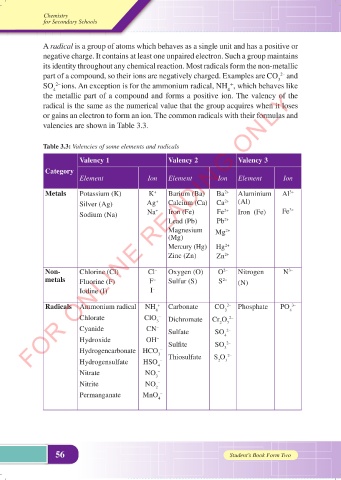
              valencies are shown in Table 3.3.


              Table 3.3: Valencies of some elements and radicals
                         Valency 1                  Valency 2            Valency 3
               Category
                         Element              Ion   Element        Ion   Element       Ion

               Metals    Potassium (K)        K +   Barium (Ba)   Ba 2+  Aluminium    Al 3+
                         Silver (Ag)         Ag +   Calcium (Ca)  Ca 2+  (Al)
                         Sodium (Na)          Na +  Iron (Fe)      Fe 2+  Iron  (Fe)  Fe 3+
                                                    Lead (Pb)      Pb 2+
                                                    Magnesium     Mg 2+
                                                    (Mg)
                                                    Mercury (Hg)  Hg 2+
                                                    Zinc (Zn)     Zn 2+

               Non-      Chlorine (Cl)        Cl –  Oxygen (O)     O 2–  Nitrogen      N 3–
               metals    Fluorine (F)         F –   Sulfur (S)     S 2–  (N)
                         Iodine (I)           I –

               Radicals  Ammonium radical    NH  +                     Carbonate  CO  2–  Phosphate  PO  3–
                                                4                    3                   4
                         Chlorate            ClO 3 –  Dichromate  Cr O  2–
                                                                   2
                                                                      7
                         Cyanide             CN –   Sulfate       SO  2–
                         Hydroxide           OH –   Sulfite       SO 4 2–
                         Hydrogencarbonate HCO   3 –                 3  2–
                         Hydrogensulfate    HSO  –  Thiosulfate   S O 3
                                                                   2
                                                 4
                         Nitrate             NO  –
                                                3
                         Nitrite             NO 2 –
                         Permanganate       MnO  –
                                                 4


                  56                                                  Student’s Book Form Two


                                                                                          01/08/2025   11:20:55
     CHEMISTRY FORM TWO NEW 2025 DUMMY.indd   56                                          01/08/2025   11:20:55
     CHEMISTRY FORM TWO NEW 2025 DUMMY.indd   56

