


Page 59 - Chemistry_Form_2
P. 59
Chemistry
              for Secondary Schools


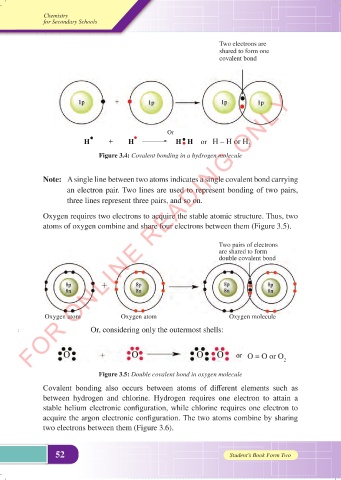
                                                                   Two electrons are
                                                                   shared to form one
                                                                   covalent bond


          FOR ONLINE READING ONLY


                                                    Or
                                                                 H – H or H 2
                               Figure 3.4: Covalent bonding in a hydrogen molecule


              Note:    A single line between two atoms indicates a single covalent bond carrying
                     an electron pair. Two lines are used to represent bonding of two pairs,
                     three lines represent three pairs, and so on.

              Oxygen requires two electrons to acquire the stable atomic structure. Thus, two
              atoms of oxygen combine and share four electrons between them (Figure 3.5).

                                                                   Two pairs of electrons
                                                                   are shared to form
                                                                   double covalent bond


               Oxygen atom            Oxygen atom                     Oxygen molecule
                            Or, considering only the outermost shells:


                                                                             O = O or O
                                                                                       2

                               Figure 3.5: Double covalent bond in oxygen molecule
              Covalent  bonding  also  occurs  between  atoms  of  different  elements such as
              between hydrogen and chlorine.  Hydrogen requires one  electron  to attain  a
              stable helium electronic configuration, while chlorine requires one electron to
              acquire the argon electronic configuration. The two atoms combine by sharing
              two electrons between them (Figure 3.6).


                  52                                                  Student’s Book Form Two


                                                                                          01/08/2025   11:20:55
     CHEMISTRY FORM TWO NEW 2025 DUMMY.indd   52                                          01/08/2025   11:20:55
     CHEMISTRY FORM TWO NEW 2025 DUMMY.indd   52

