


Page 57 - Chemistry_Form_2
P. 57
Chemistry
              for Secondary Schools


              (e)   They are generally  insoluble in non-polar solvents such as  carbon
                    tetrachloride and hexane. Non-polar solvents contain bonds between atoms
                    with similar electronegativities.
              (f)   They are typically hard but brittle.
          FOR ONLINE READING ONLY
              (g)   They have high densities.


                       Activity 3.1


              Aim: To investigate the electrovalent bonding in substances

              Requirements: Table salt (sodium chloride), cooking oil, slaked lime, baking
                              powder, sugar, three glass beakers, distilled water, a tablespoon,
                              an electrical conductivity meter (or a small LED bulb with wires
                              and a battery), and three stirring rods

              Procedure

              1.  Fill a glass beaker with distilled water and add 2 tablespoons of table salt
                   (sodium chloride). Stir with the stirring rod until the salt dissolves completely.

              2.  Attach the electrical  conductivity  meter  (or set up the bulb circuit)  to
                   the solution.  Observe whether the  bulb lights up or the tester  indicates
                   conductivity.

              3.  Repeat Steps 1 and 2 for the baking powder, cooking oil, slaked lime, and
                   sugar. Use a separate stirring rod for each substance.
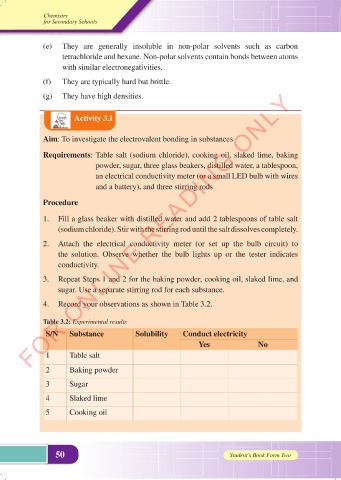
              4.  Record your observations as shown in Table 3.2.


              Table 3.2: Experimental results
               S/N    Substance           Solubility    Conduct electricity
                                                             Yes               No
               1      Table salt

               2      Baking powder

               3      Sugar
               4      Slaked lime

               5      Cooking oil


                  50                                                  Student’s Book Form Two


                                                                                          01/08/2025   11:20:55
     CHEMISTRY FORM TWO NEW 2025 DUMMY.indd   50                                          01/08/2025   11:20:55
     CHEMISTRY FORM TWO NEW 2025 DUMMY.indd   50

