


Page 56 - Chemistry_Form_2
P. 56
Chemistry
                                                                           for Secondary Schools


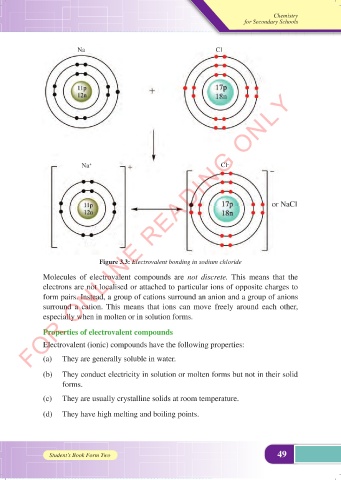
                        Na                                        Cl


          FOR ONLINE READING ONLY


                          Na +                                      Cl –


                                                                                   or NaCl


                               Figure 3.3: Electrovalent bonding in sodium chloride
              Molecules of electrovalent  compounds are  not discrete.  This means that the
              electrons are not localised or attached to particular ions of opposite charges to
              form pairs. Instead, a group of cations surround an anion and a group of anions
              surround  a cation.  This means that  ions can move freely  around each other,
              especially when in molten or in solution forms.

              Properties of electrovalent compounds
              Electrovalent (ionic) compounds have the following properties:

              (a)   They are generally soluble in water.

              (b)   They conduct electricity in solution or molten forms but not in their solid
                    forms.
              (c)   They are usually crystalline solids at room temperature.

              (d)   They have high melting and boiling points.


                Student’s Book Form Two                                              49


                                                                                          01/08/2025   11:20:54
     CHEMISTRY FORM TWO NEW 2025 DUMMY.indd   49                                          01/08/2025   11:20:54
     CHEMISTRY FORM TWO NEW 2025 DUMMY.indd   49

