


Page 54 - Chemistry_Form_2
P. 54
Chemistry
                                                                           for Secondary Schools


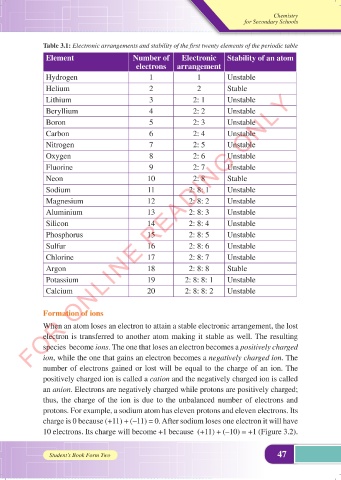
              Table 3.1:  Electronic arrangements and stability of the first twenty elements of the periodic table
               Element                   Number of      Electronic    Stability of an atom
                                          electrons    arrangement
               Hydrogen                       1              1        Unstable
               Helium                         2              2        Stable
          FOR ONLINE READING ONLY
               Lithium                        3            2: 1       Unstable
               Beryllium                      4            2: 2       Unstable
               Boron                          5            2: 3       Unstable
               Carbon                         6            2: 4       Unstable
               Nitrogen                       7            2: 5       Unstable
               Oxygen                         8            2: 6       Unstable
               Fluorine                       9            2: 7       Unstable

               Neon                           10           2: 8       Stable
               Sodium                         11          2: 8: 1     Unstable
               Magnesium                      12          2: 8: 2     Unstable
               Aluminium                      13          2: 8: 3     Unstable
               Silicon                        14          2: 8: 4     Unstable
               Phosphorus                     15          2: 8: 5     Unstable
               Sulfur                         16          2: 8: 6     Unstable

               Chlorine                       17          2: 8: 7     Unstable
               Argon                          18          2: 8: 8     Stable
               Potassium                      19         2: 8: 8: 1   Unstable
               Calcium                        20         2: 8: 8: 2   Unstable


              Formation of ions
              When an atom loses an electron to attain a stable electronic arrangement, the lost
              electron is transferred to another atom making it stable as well. The resulting
              species  become ions. The one that loses an electron becomes a positively charged
              ion, while the one that gains an electron becomes a negatively charged ion. The
              number of electrons gained or lost will be equal to the charge of an ion. The
              positively charged ion is called a cation and the negatively charged ion is called
              an anion. Electrons are negatively charged while protons are positively charged;
              thus, the charge of the ion is due to the unbalanced number of electrons and
              protons. For example, a sodium atom has eleven protons and eleven electrons. Its
              charge is 0 because (+11) + (–11) = 0. After sodium loses one electron it will have
              10 electrons. Its charge will become +1 because  (+11) + (–10) = +1 (Figure 3.2).


                Student’s Book Form Two                                              47


                                                                                          01/08/2025   11:20:54
     CHEMISTRY FORM TWO NEW 2025 DUMMY.indd   47                                          01/08/2025   11:20:54
     CHEMISTRY FORM TWO NEW 2025 DUMMY.indd   47

