


Page 53 - Chemistry_Form_2
P. 53
Chemistry
              for Secondary Schools


          FOR ONLINE READING ONLY


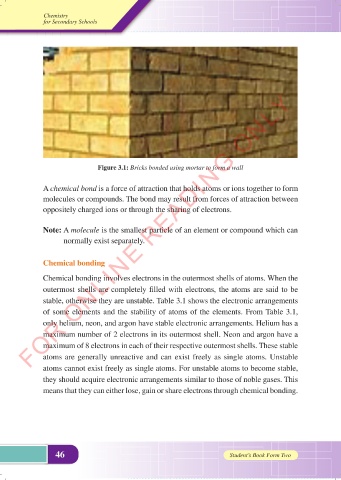
                               Figure 3.1: Bricks bonded using mortar to form a wall

              A chemical bond is a force of attraction that holds atoms or ions together to form
              molecules or compounds. The bond may result from forces of attraction between
              oppositely charged ions or through the sharing of electrons.


              Note: A molecule is the smallest particle of an element or compound which can
                    normally exist separately.


              Chemical bonding

              Chemical bonding involves electrons in the outermost shells of atoms. When the
              outermost shells are completely filled with electrons, the atoms are said to be
              stable, otherwise they are unstable. Table 3.1 shows the electronic arrangements
              of some elements and the stability of atoms of the elements. From Table 3.1,
              only helium, neon, and argon have stable electronic arrangements. Helium has a
              maximum number of 2 electrons in its outermost shell. Neon and argon have a
              maximum of 8 electrons in each of their respective outermost shells. These stable
              atoms are generally unreactive and can exist freely as single atoms. Unstable
              atoms cannot exist freely as single atoms. For unstable atoms to become stable,

              they should acquire electronic arrangements similar to those of noble gases. This
              means that they can either lose, gain or share electrons through chemical bonding.


                  46                                                  Student’s Book Form Two


     CHEMISTRY FORM TWO NEW 2025 DUMMY.indd   46                                          01/08/2025   11:20:54
                                                                                          01/08/2025   11:20:54
     CHEMISTRY FORM TWO NEW 2025 DUMMY.indd   46

