


Page 55 - Chemistry_Form_2
P. 55
Chemistry
              for Secondary Schools


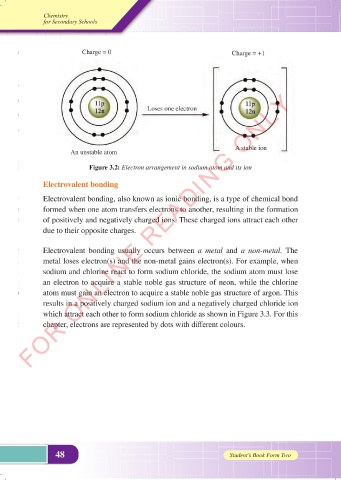
                          Charge = 0                                   Charge = +1


          FOR ONLINE READING ONLY


                                              Loses one electron


                                                                        A stable ion
                      An unstable atom

                            Figure 3.2: Electron arrangement in sodium atom and its ion

              Electrovalent bonding
              Electrovalent bonding, also known as ionic bonding, is a type of chemical bond
              formed when one atom transfers electrons to another, resulting in the formation
              of positively and negatively charged ions. These charged ions attract each other
              due to their opposite charges.


              Electrovalent bonding usually occurs between  a  metal  and  a non-metal.  The
              metal loses electron(s) and the non-metal gains electron(s). For example, when
              sodium and chlorine react to form sodium chloride, the sodium atom must lose
              an electron to acquire a stable noble gas structure of neon, while the chlorine
              atom must gain an electron to acquire a stable noble gas structure of argon. This
              results in a positively charged sodium ion and a negatively charged chloride ion
              which attract each other to form sodium chloride as shown in Figure 3.3. For this
              chapter, electrons are represented by dots with different colours.


                  48                                                  Student’s Book Form Two


                                                                                          01/08/2025   11:20:54
     CHEMISTRY FORM TWO NEW 2025 DUMMY.indd   48                                          01/08/2025   11:20:54
     CHEMISTRY FORM TWO NEW 2025 DUMMY.indd   48

